
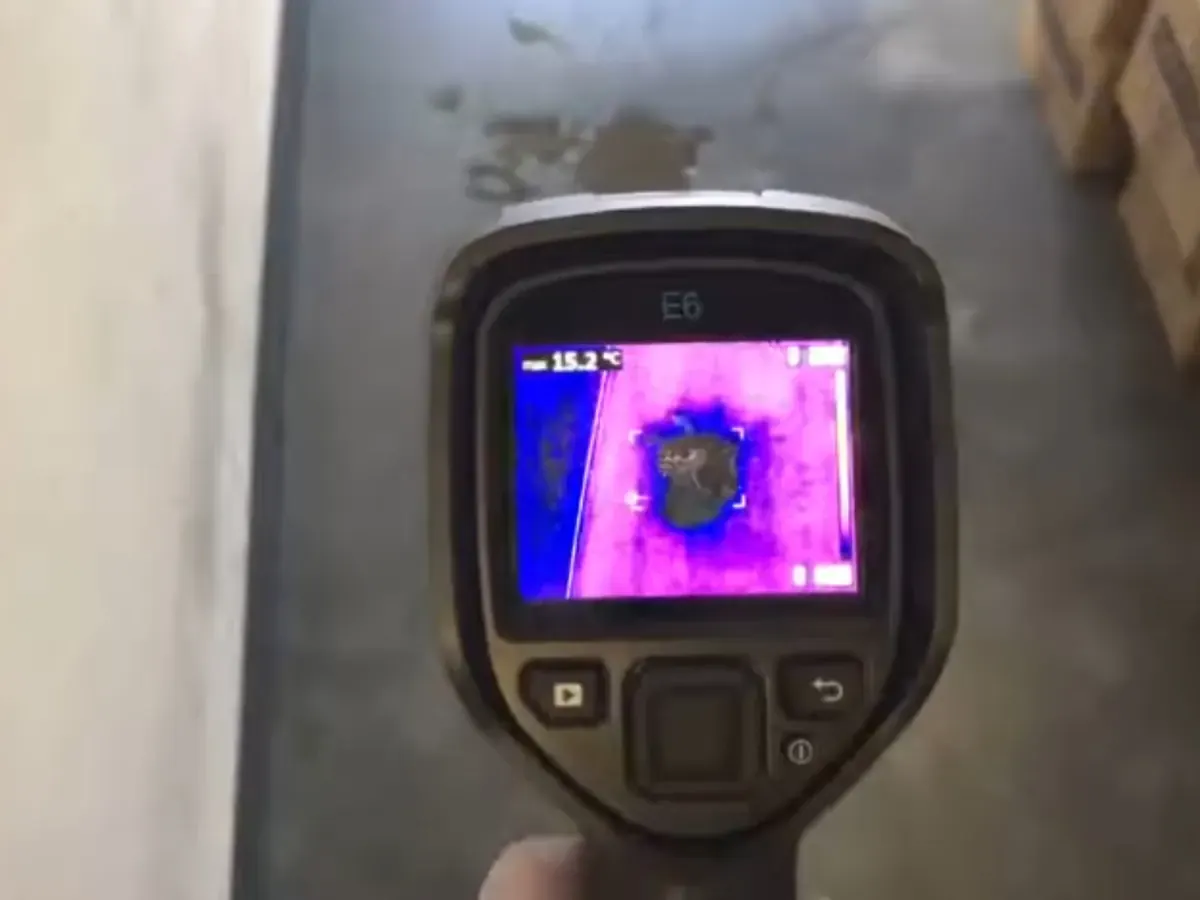
To check for a hidden leak, turn off every water use in the house, then watch the water meter. If the leak indicator or dial moves while nothing is running, water is escaping somewhere. Then check the toilets with a few drops of food coloring in each tank, because a silent toilet leak is the most common cause of a high bill.
If those tests point to a leak, the next step is to find where. That is where listening devices, thermal cameras and pressure tests come in, and where a plumber saves you from opening walls at random.
Below are the two tests, a table of signs, a list of the usual hiding places and a local note on the utility and permit rules that apply in Maryland Heights.
The meter test
This takes about fifteen minutes and costs nothing.
Stop all water use
Turn off the dishwasher, washer, ice maker and any irrigation, and make sure no one is using water.
Read the meter
Open the meter box and note the dial or the small leak indicator, often a triangle or a star that spins with low flow.
Wait fifteen minutes
Do not use any water, then read it again.
Compare
If the dial or the indicator moved, water is leaking somewhere between the meter and the fixtures.
If the meter moves and the toilets pass the dye test, the leak is in a supply line, the water heater, an appliance hose or a buried line. That is a leak detection job.
The toilet dye test
Put a few drops of food coloring in each toilet tank without flushing. Wait fifteen minutes. If color shows up in the bowl, the flapper is leaking and water is slipping past the seal.
A leaking flapper can waste a large amount of water over a month without making any sound. It is also one of the cheapest leaks to fix, and a new flapper or fill valve often solves it. Our toilet repair crews can handle that visit.
Signs that point to a leak
| What you see | Where to look | What it may mean |
|---|---|---|
| Water bill jumps with no change in use | The meter and the toilets | A running toilet or a hidden supply leak |
| Stain or bubble on a ceiling | The room above, the attic and the bathroom plumbing | A leaking drain or supply line overhead |
| Warm spot on the floor | The floor over the water heater line | A hot line leak under the floor |
| Musty smell or mold | Under sinks, in cabinets and in closets | A slow leak at a trap or a valve |
| Sound of running water at night | The wall near the meter or the water heater | A leak in a pressurized line |
| Wet or green patch in the yard | The line between the meter and the house | A buried water line leak |
Most leaks leave more than one sign. A stain and a high bill together are a stronger case than either alone.
The usual hiding places
Check these before you call
- The shutoff valves and supply lines under every sink and behind every toilet.
- The base and the pressure relief discharge of the water heater.
- Hoses behind the washing machine and the refrigerator ice maker line.
- The area around tubs and showers for loose caulk or soft floors.
- Outdoor hose bibs and any irrigation lines.
A damp spot that returns after wiping is a leak, even if it is small. If the source is not obvious, a plumber can use acoustic and thermal tools to find it without opening the wall.
Maryland Heights local note: the utility and permits
The City of Maryland Heights lists Missouri American Water as the water utility for the community and gives its customer line as 1-866-430-0820. If your meter test shows a leak, you can ask the utility about the meter and your usage history, which helps separate a leak from a change in use.
The city's permits page lists stopping leaks as ordinary repair that does not need a plumbing permit. That means a straight repair of a leaking fitting does not require a permit visit, while work that replaces water lines is handled by the Community Development Building Division at (314) 291-6550.
Source: City of Maryland Heights, community information and residential plumbing permits pages (city government).
What to write down before you call
Record the meter reading, the time and the result of each test, and take a photo of any stain or damp spot. Note which fixtures were in use and whether the sound of running water comes and goes. Those details let the dispatcher decide how fast to send a crew and which tools to bring.
Also note when the bill changed. A jump that starts on one billing cycle points to a new leak, while a slow climb over several months suggests a worn flapper or a dripping fitting. If you rent, send the same notes to your landlord or property manager so the repair request is clear.
When to call a plumber
Call a plumber if the meter moves and you cannot find the source, if you see damp walls or floors or if a wet spot is growing. A pro can use listening devices and pressure tests to find a leak without cutting more drywall than needed, and our leak detection page explains the tools.
If a pipe has already burst or water is pouring from a fitting, shut off the main valve and call right away. Our burst pipe repair crews work around the clock, and we serve homes in Creve Coeur and Hazelwood as well as Maryland Heights.
A standard for reading your water meter
The leak test in this guide works because the meter registers any flow, and the utility's own guidelines tell customers to shut off every fixture and watch the leak indicator. If it moves with everything off, water is escaping somewhere between the meter and the fixtures.
Missouri American Water at 1-866-430-0820 can say what its guidelines are for a suspected leak on your account.
Plumbing leak detection questions
A warm spot on the floor, the sound of running water and a meter that moves with everything off are the clues. A plumber can pinpoint it with acoustic tools.
Yes. A flapper that leaks lets water run into the bowl all day. The dye test finds it in fifteen minutes.
A slow movement can be a leak. Use the leak indicator if your meter has one, and repeat the test to be sure.
Policies vary. Sudden leaks are often covered while long term seepage is not. Ask your insurer and keep photos and records.
Call Missouri American Water at 1-866-430-0820 to ask about the meter and your usage, then call a plumber if a leak test points to your pipes.