
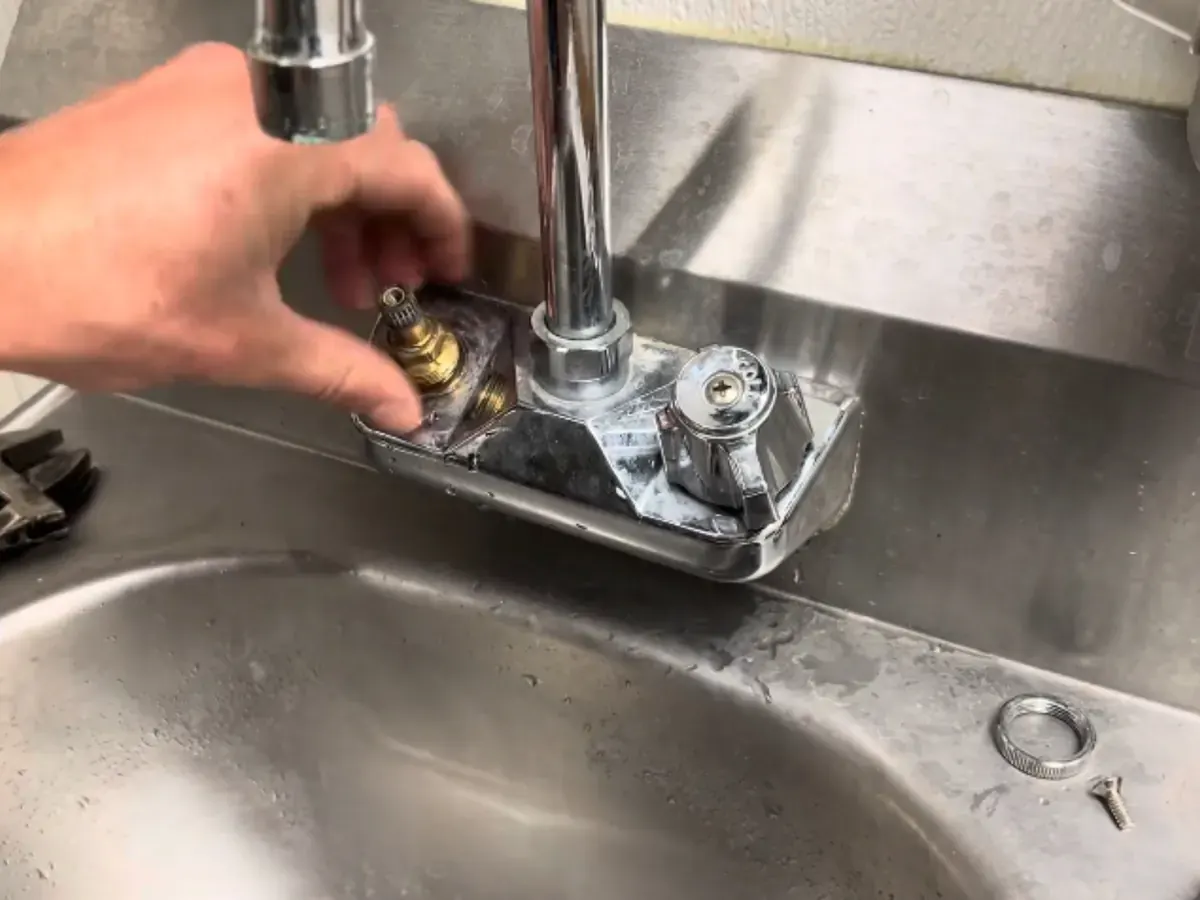
If water is spraying from under a sink or a valve will not shut off, close the main water valve first. Our dispatch line is open 24/7, and same-day appointments are offered when available. The main valve is usually near where the water line enters the house, and turning it clockwise stops water to every fixture while you wait.
Fixture problems often start small. A drip at the spout, a handle that turns with no effect or water around the base of a shower valve all mean something inside has worn out.
We repair the fixture when the parts are sound, replace it when they are not, and swap out failed shutoff valves so the next repair does not need the whole house turned off.
A valve that will not shut off: the emergency version
When the shutoff itself has failed
An angle stop under a sink or behind a toilet can seize with mineral scale, and old multi-turn valves can break at the stem when forced. If the valve under a leaking faucet will not close, the water has to be stopped at the main.
Turn off the main valve, open a faucet at the lowest level of the house to drain the pipes and call. We replace the failed valve with a quarter-turn type, which closes fully with a short turn and is far less likely to jam.
Why faucets leak: cartridges, balls and washers
The inside of a faucet determines the repair. The common types fail in different ways.
Compression faucets
Two handles with rubber washers. A drip means the washer or seat is worn.
Cartridge faucets
One or two handles with a plastic or brass cartridge. Leaks at the spout mean the cartridge or its O-rings need replacing.
Ball faucets
Single handle with a rotating ball, common on kitchen sinks. Leaks at the base point to worn seals and springs.
Ceramic disc faucets
Smooth quarter-turn handle. Sediment can scratch the discs and cause a slow drip.
If the faucet is more than a few years old and the parts are hard to find, replacing the whole fixture is often the better value, and we install one you choose or one we recommend.
Burst or broken supply lines and angle stops
The flexible lines that connect faucets to the wall are a common failure point. A braided line can burst at the coupling, and a plastic nut can crack when overtightened.
We replace them with new braided stainless lines and test every connection under pressure. If the valve at the wall also shows corrosion, we replace it in the same visit so you are not calling again in a month.
Water damage to cabinets and floors begins quickly. If you see moisture in a cabinet, shut off the water and call the same day.
Shower valves, showerheads and tub faucets
Bath fixtures hide most of their parts behind the wall, so the symptom usually points to the part.
| Symptom | Likely cause | Typical fix |
|---|---|---|
| Drip from the tub spout when the shower runs | Diverter or the valve cartridge | Replace the diverter or cartridge |
| Water that will not get hot or goes cold suddenly | Worn mixing cartridge or a failing water heater | Replace the cartridge, then check the heater |
| Showerhead that sprays sideways or weakly | Scale in the nozzles | Soak or replace the head |
| Water behind the wall or a stain on the ceiling below | Leaking valve body or a connection | Open the wall, repair or replace the valve |
A stain below a bathroom that keeps growing should not wait. We trace the source and, if the wall is involved, bring in leak detection before opening anything.
Slow tub and shower drains
A faucet that works well while the tub drains slowly is usually a hair or soap clog at the drain or the trap. We clear those with a cable sized for tub drains, and if the whole house is slow, the cause may be further down.
Our drain cleaning crews handle both, and the same visit can fix the faucet and the drain together.
Kitchen faucets, double sinks and the plumbing under them
A kitchen faucet works alongside the supply lines, the drain, the trap and often a dishwasher and disposal. A drip under the sink can come from any of them, so we check the whole cabinet before replacing a faucet.
Double sinks add a tailpiece and a continuous waste, which are easy places for a slow leak to hide. When a disposal is part of the setup, we tie in the garbage disposal connection as well.
Permits for sink and faucet work
What the city says
The City of Maryland Heights lists replacing a sink or faucet with no relocation as ordinary work that does not need a permit. Moving a sink to a different wall or adding a new fixture changes that, and the building division at (314) 291-6550 can confirm what your project needs.
What affects the price of faucet and valve repair
You hear a clear price before work starts. These are the factors.
Repair or replace
A cartridge swap is small. A new fixture adds the cost of the fixture.
Valve condition
A seized shutoff may need replacing before the faucet can be worked on.
Behind-the-wall access
Shower valves can need an access panel or opened wall.
Fixture brand and availability
Some brands need special parts.
After-hours timing
Night and weekend dispatch is priced differently.
Sudden water damage from a burst line may be covered by your homeowner policy, while worn parts usually are not, so ask your insurer. For your own number, call the dispatch line.
Faucet repair around Maryland Heights
We repair fixtures across the 63043 ZIP code and in neighboring areas, including Bridgeton. For toilet and drain problems, see toilet repair.
Standards that apply to faucets and supply lines
Plumbing supply fittings are covered by the ASME A112.18.1 and CSA B125.1 standard, and EPA WaterSense labels bathroom faucets that flow at 1.5 gallons per minute or less. A faucet that drips from the spout or the handle usually needs a cartridge or seat, and buying the right part depends on the make and model.
Replacing a faucet with no relocation is ordinary repair under the City of Maryland Heights permit rules. A relocated sink is not, so confirm with the building division.
Safety steps before you open a faucet
Do these first
- Close the shutoff valve under the sink or the main if the valve will not turn.
- Open the faucet to drain pressure before you unscrew anything.
- Plug the drain so small parts do not fall in.
- Keep power tools and cords away from the wet area.
Faucet and valve questions from Maryland Heights homeowners
Yes. If a faucet or shutoff valve will not close and water keeps flowing, call whenever it happens. Closing the main shutoff buys you time, and the 24/7 line books the earliest slot open that day with the price given first.
Do not force it. Shut off the main water valve for the house and call us, and we will replace the valve with a quarter-turn shutoff.
A worn washer, cartridge, seal or disc is the usual cause. Which part depends on the faucet style.
Repair works when parts are available and the finish is good. Replace when the fixture is old, corroded or the part costs nearly as much as a new faucet.
The valve body or a supply connection may be leaking. We trace it, and if needed, open a small section to repair it.
The City of Maryland Heights says replacing a sink or faucet with no relocation does not need a permit. Moving the fixture to a new location is a different case.