
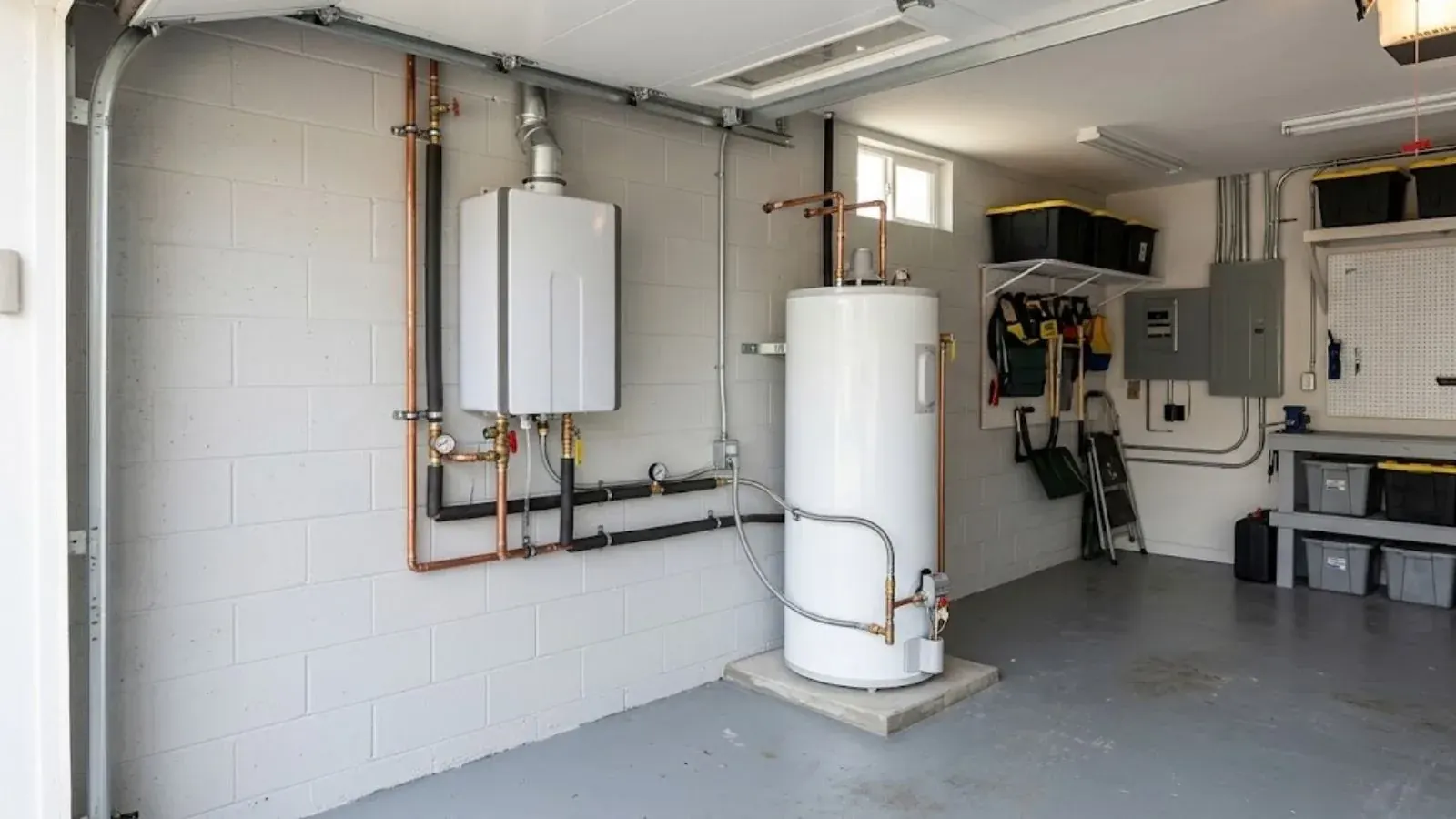
A tankless water heater heats water as it flows instead of storing it, which is why it can run out of tank-sized limits but not out of hot water. The trade-off is that it works harder per minute, so the gas line, vent or electric circuit has to be sized for the demand.
We install, repair and flush tankless units in Maryland Heights. Same-day appointments are offered when available, and you get a clear price before work starts.
Flushing and descaling a tankless heater
Scale is the most common reason tankless heaters lose efficiency and throw error codes. Minerals bake onto the heat exchanger and narrow the water passages until flow drops.
Isolate the heater
The plumber shuts off the gas or power and closes the isolation valves that most units have on the hot and cold lines.
Connect a pump and descaling solution
A small pump circulates a food-safe descaling liquid through the heat exchanger. The loop runs long enough to dissolve scale.
Flush and clean the filter
Fresh water rinses the loop, and the inlet screen is cleaned or replaced.
Restart and test
The unit is brought back online, checked for flow and temperature and any stored error codes are reviewed.
How often a unit needs this depends on your water. The Missouri American Water 2021 report for its St. Louis County system shows hardness between about 4.4 and 9.9 grains per gallon at its Missouri River plants, and a home in that range often benefits from a yearly service. Test your tap for your own number.
When to choose tankless over a tank
A tankless unit is a good fit in some homes and a poor fit in others. This table summarizes the main trade-offs.
| Factor | Tankless | Tank |
|---|---|---|
| Space | Wall mounted, compact | Floor space needed |
| Hot water supply | Continuous within the unit's flow limit | Limited to tank volume before recovery |
| Install complexity | Larger gas line, new vent or high-amp circuit | Usually reuses existing connections |
| Maintenance | Yearly descaling is important in hard water | Yearly flush recommended |
| Upfront work | Typically more | Typically less |
Our water heater installation page covers tank options for the same decision.
Gas or electric tankless
Gas tankless heaters need a gas line that can deliver enough BTUs for the unit's input, plus a sealed vent to the outside. An older home with a half inch gas supply may need a larger line before a tankless unit can run at full output.
Electric tankless units draw a lot of current. A whole-house model may need multiple dedicated breakers, so the plumber looks at the electrical panel before quoting.
If you smell gas at any time, leave the building and call Spire at (314) 621-6960 or 911 before calling a plumber.
Error codes and what they often mean
Every manufacturer uses different codes, so the number on the display is only a clue. These groupings are common across most brands.
| Type of code | Often points to | First check |
|---|---|---|
| Ignition or flame | Gas supply, igniter or dirty flame rod | Is the gas valve open and the vent clear? |
| Flow or flow sensor | Scale or a clogged inlet screen | Clean the screen and flush the unit |
| Temperature or overheat | Scale on the heat exchanger | Descale and verify water flow |
| Vent or exhaust | Blocked or damaged vent | Inspect the flue termination |
Write down the code, the model and what the unit was doing when it faulted. That helps the plumber arrive with the right parts.
Replacing a tank with a tankless unit
What a tank-to-tankless swap usually needs
- A gas line sized for the unit's input or an electrical panel that can feed it.
- A sealed vent path to the outside that meets the manufacturer's rules.
- A condensate drain for high-efficiency condensing units.
- A wall space with clearance around the unit.
- A plan for scale control, such as isolation valves and a descaling schedule.
If the current tank is already failing, our replacement page explains how that emergency version works.
Repairs on tankless units
Tankless repairs usually come down to scale, a failed sensor, a bad igniter or a venting problem. A plumber who has serviced these units knows which part to test first.
If the unit is old and the heat exchanger is badly scaled, replacement may cost less than repeated service. We explain both options before work starts.
Permits and gas work in Maryland Heights
The City of Maryland Heights permits page says permits can be pulled without plans for replacing water heaters up to 120 gallons. It does not say how it treats a new tankless unit with a larger gas line, so ask the building division at (314) 291-6550 what applies to your project.
Gas line changes and venting are the parts most likely to draw inspection attention. We explain the permit step before the work is scheduled.
What affects the price of tankless work
Unit and capacity
Flow rate and gas input drive the equipment cost.
Gas line and venting
A larger gas line or a new vent adds labor and materials.
Electrical needs
Electric models may need new breakers or a panel upgrade.
Scale condition
A unit that has not been flushed in years may need extra cycles.
Access
Wall mounting and tight spaces change the time.
Call the dispatch line for your own number. We also work in Hazelwood and nearby ZIP codes.
Standards and rules for tankless units
Gas tankless units are built to ANSI Z21.10.3 and need venting and gas piping sized to the manufacturer's installation standard. That is why a tankless swap often costs more than a tank swap, since the existing gas line and flue may not meet the new unit's requirements.
The permits page of the City of Maryland Heights does not spell out tankless gas work. Ask the building division at (314) 291-6550 what it requires before you buy a unit.
Tankless water heater questions
It depends on your water. Hard water speeds scale buildup, so many homes in this area flush yearly. Test your tap and ask the plumber for a schedule based on the result.
Codes vary by brand, but common causes are scale, a clogged inlet screen, a gas supply problem or a blocked vent. Note the code and call us.
Often yes, but the gas line, vent and electrical supply need to match the unit. The plumber checks all three before quoting.
It provides continuous hot water up to the unit's flow limit. Running several showers and a washer at once can exceed that limit.
We service the major brands. Tell us the make and model when you call so we can bring the right parts.