
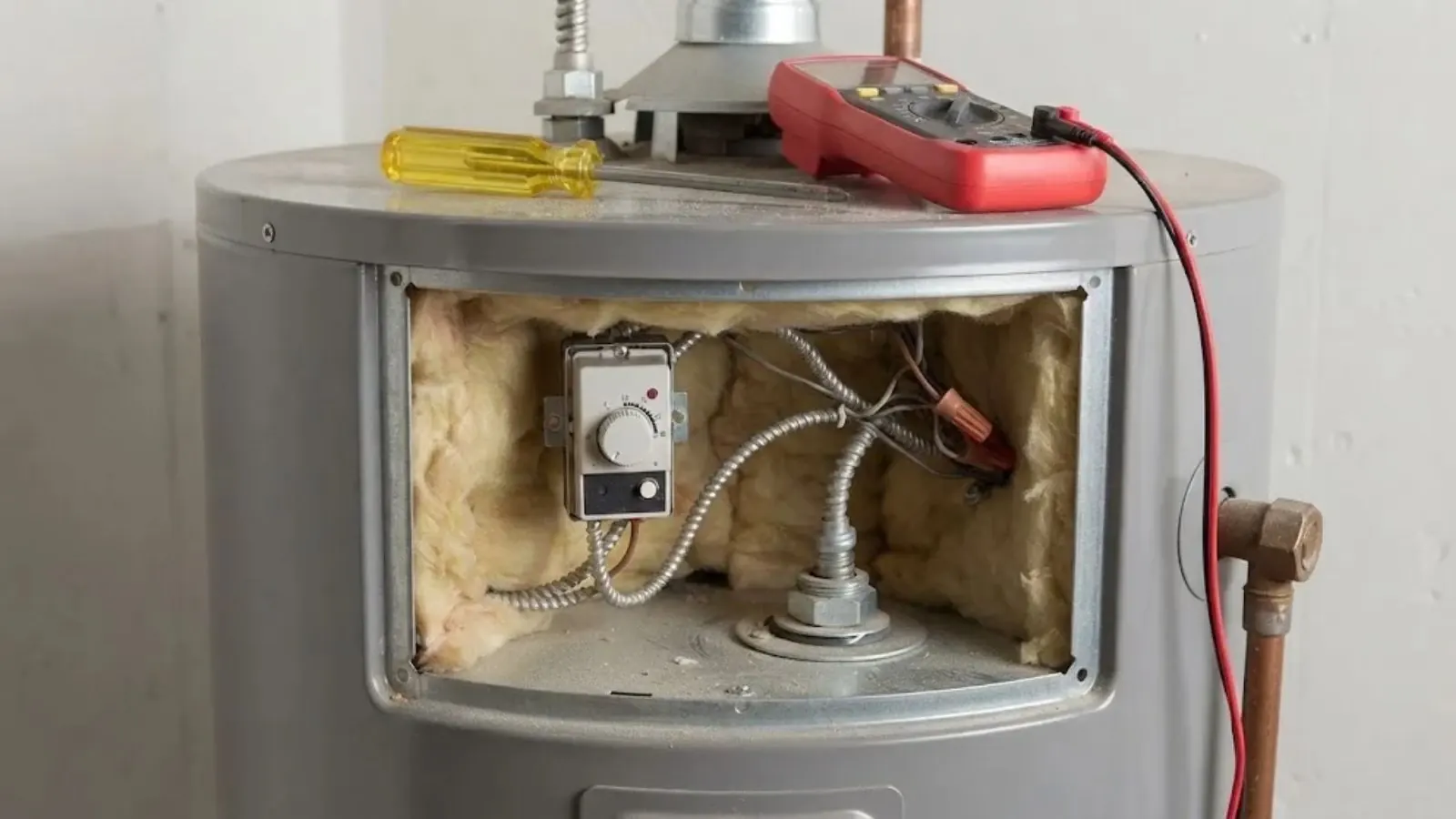
Water on the floor around a water heater is an emergency repair call, and so is a house with no hot water on a cold morning. Our 24/7 line is answered around the clock, and we book same-day appointments when available across Maryland Heights.
While you wait, close the cold water valve on the pipe entering the top of the tank and switch off the electric breaker for the heater. On a gas unit, turn the gas control knob to off or pilot, but only if you do not smell gas. If you do smell gas, leave the building and call Spire at (314) 621-6960 or 911 before you call us.
Most repairs are finished in one visit because the plumber carries common elements, thermostats, valves and thermocouples. When the tank itself has failed, we say so plainly and explain the replacement options before you spend money on a repair that will not last.
When a leaking water heater is an emergency
A slow drip at a fitting can wait for a morning appointment. Water spreading across a floor cannot, because a full 40 or 50 gallon tank can empty in a few minutes once a seam gives way.
Shut off the cold supply
Turn the handle on the cold inlet pipe clockwise until it stops. If the valve is stuck, use the main shutoff where the water line enters the house.
Cut the power or gas
Flip the breaker for an electric heater, since heating elements burn out fast when the tank is empty. For gas, set the control to off and open a window if the room is closed in.
Move what the water will reach
Lift boxes, rugs and cardboard off the floor. Water finds floor drains, and it also finds the drywall bottom plate.
Call and describe the leak
Tell the dispatcher where the water is coming from, such as the top, the side seam or the drain valve. That helps us bring the right parts.
If the tank is already empty and the house has no hot water, the next step is deciding between repair and water heater replacement, which the table below walks through.
Where a puddle under the tank really comes from
Homeowners often find water at the edge of a garage slab or in a utility closet and assume the tank is finished. In practice, several different parts leak, and only one of them means a new heater.
Tank body or seam
Water running from the bottom or the side jacket means the steel tank has corroded through. This is not repairable, and replacement is the next step.
Inlet and outlet fittings
A weeping connection at the top is often a loose union or a failed flex connector. These are inexpensive fixes that take under an hour.
Temperature and pressure relief valve
The TPR valve and its discharge pipe release water when pressure or heat climbs. A steady drip can mean high water pressure or a worn valve.
Drain valve
The brass or plastic valve near the bottom can drip after a flush. Replacing it takes a short visit if the tank is otherwise sound.
Condensation
A cold tank in a warm room can sweat, and a high-efficiency gas unit makes condensate by design. Check that the puddle is actually clear and not rusty.
A puddle that appears at the slab edge near the garage may travel from a leak elsewhere. If the heater is dry on top and the floor stays wet, our leak detection crew can trace the supply line before anyone replaces the wrong thing.
No hot water or lukewarm water: what usually failed
When the shower runs cold, the symptom narrows the list quickly. The two columns below match what we see most often on gas and electric tanks.
| Symptom | Gas tank, likely cause | Electric tank, likely cause |
|---|---|---|
| No hot water at all | Pilot out, bad thermocouple or failed gas valve | Tripped breaker, burnt upper element or failed upper thermostat |
| Water warms then turns cold fast | Sediment layer blocking the burner | Lower element failed or dip tube broken |
| Water is hot but runs out quickly | Sediment or undersized tank for the household | One element working, the other dead |
| Popping or rumbling noise | Scale boiling under the sediment layer | Scale on the elements |
| Rusty or smelly hot water | Anode rod used up | Anode rod used up |
Many of these parts are routine repairs. If the tank is leaking from the body, or if it has already needed repeated repairs, a new unit is the sound choice.
Gas, electric and hybrid heaters fail in different ways
A gas water heater adds combustion to the list of things that can go wrong. The burner, the flue draft and the gas control valve are all safety components, so a plumber checks venting and flame quality before calling the repair done.
Electric tanks are simpler. They fail at the elements, the thermostats and the high-limit reset button, and a multimeter tells us which part is dead within minutes.
Hybrid heat pump models combine a compressor with backup elements. They need more clearance and a drain for condensate, and they are covered best by a technician who has worked on them before. Tell the dispatcher the make and model if you know it, because it changes which parts we carry.
What Missouri River water does to a tank
Water chemistry and sediment
Missouri American Water supplies Maryland Heights. Its 2021 water quality report for the St. Louis County system lists total hardness at its Missouri River plants between 76 and 170 ppm as calcium carbonate, which is roughly 4.4 to 9.9 grains per gallon.
Water in that range deposits scale on heating elements and settles as sediment at the bottom of a tank. That is why tanks in this area often show popping noises and shortened element life. If you want your own number, test your tap, since the 2021 figures describe the utility's plants and not your pipes.
Flushing a tank once a year clears loose sediment and extends element life. If your water is on the hard side, a water softener protects the heater and the fixtures.
Repair or replace: a simple way to decide
We recommend repair when the problem is a part and the tank is sound. We recommend replacement when the tank is the problem or when repeated repairs are adding up.
| Situation | Usually better to repair | Usually better to replace |
|---|---|---|
| Leak location | Fitting, valve or connector | Tank body or seam |
| Failed part | Element, thermostat, thermocouple | Gas valve plus a second failed part |
| Tank condition | Clean inside, no rust streaks | Heavy sediment, rust in the hot water |
| Repair history | First repair in years | Third repair in a short stretch |
| Household need | Hot water volume is fine | Running out of hot water regularly |
Replacement pricing and options are on our replacement page, and a planned job costs less than the same job at 2 a.m. when a tank fails without warning.
What affects the price of a water heater repair
You get a clear price before work starts. These factors move the number.
The failed part
A thermostat or element is a smaller job than a gas control valve or a relief valve with corroded threads.
Tank age and condition
A sound tank is worth a repair. A tank with a rotted bottom is not.
Fuel type and venting
Gas work includes checking the flue and combustion air, and electric work includes testing the circuit.
Access
A heater in a tight closet or a crawlspace takes longer to service than one in an open basement.
Timing
Night and holiday dispatch is priced differently from a weekday appointment, and you hear the difference before we start.
Homeowner policies often exclude leaks from wear and corrosion, though sudden water damage may be covered, so ask your insurer before assuming. For your exact number, call our dispatch line and describe the heater.
Water heater repair in nearby towns
We also repair tanks in Creve Coeur and across the 63043, 63146 and 63045 ZIP codes around Maryland Heights. Give the dispatcher your cross streets and we will tell you plainly whether we can be there today.
What the standards say about water heater safety
Gas-fired storage water heaters are built to the ANSI Z21.10.1 standard and electric tanks to UL 174, and both require a temperature and pressure relief valve. A relief valve that drips is doing its job, and one that never lets go is a problem the tank cannot solve for itself.
The City of Maryland Heights allows permits for water heaters up to 120 gallons to be pulled without plans. Repairs that do not replace the tank need no permit, so ask the building division if the job grows.
Water heater repair questions from Maryland Heights homeowners
Yes. A tank that is leaking, scalding or stone cold at 2 a.m. is exactly what the 24/7 line is for. If you can, switch off the power or gas supply to the heater first, and tell the dispatcher what you did so the plumber arrives with the right parts and a clear price.
A valve that drips can be doing its job by releasing pressure, or it can be worn out. Do not cap the discharge pipe, because the valve is a safety device. Call us to test the water pressure and the valve.
Scale and sediment collect at the bottom of the tank, and water trapped under them boils and pops. Hard water speeds this up, and a flush often quiets the noise if the tank is not too far gone.
A pilot that keeps going out often points to a worn thermocouple or a draft problem. Do not keep relighting it if you smell gas. Leave the building and call Spire at (314) 621-6960 or 911 first.
A leak from the tank bottom or seam means the steel has corroded through, and replacement is the right fix. A leak from a fitting, valve or connector is usually a repair.
Yes. Property managers can call the same 24/7 line, and we explain the repair or replacement options before work starts so the owner can approve them.