
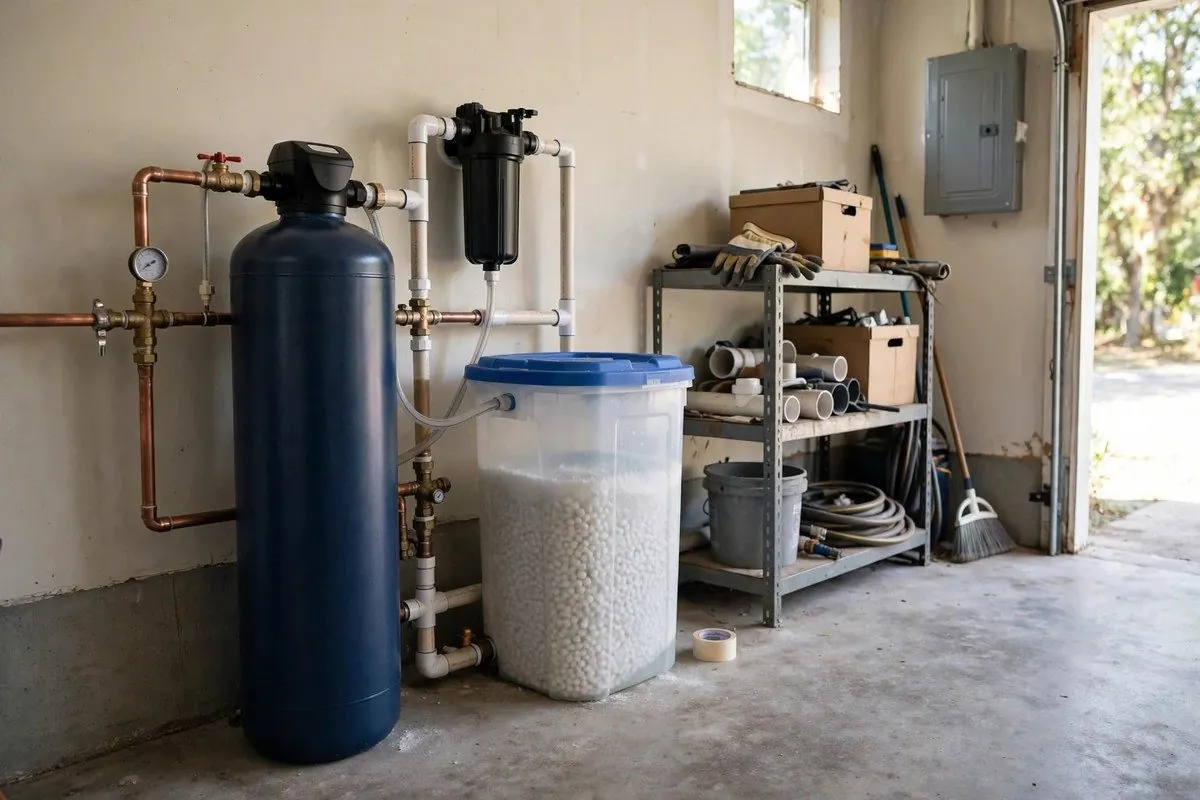
Hard water leaves white scale on faucets, spots on dishes and a crust inside water heaters. A water softener removes the minerals that cause it, and a filter handles taste, odor and chlorine. They solve different problems, and many homes need only one.
We book same-day appointments when available for a water test and an install plan, and you get a clear price before work starts. The first step is always a test of your own tap, not a guess.
Test your tap before you buy anything
Water chemistry changes from one system to another, and even from one tap to another in the same house.
What a test tells you
- Total hardness, which sizes the softener and sets how often it regenerates.
- Iron, if your water leaves orange stains, because iron changes the equipment you need.
- Chlorine or chloramine, if taste and odor are the complaint, because that calls for a filter.
- Whether the problem is the water or the plumbing, such as a corroded line or a dirty aerator.
A home test kit gives a rough number and a lab test gives a precise one. We can test at the tap during the visit and explain what the number means.
What Missouri American Water reports for this area
Maryland Heights is served by Missouri American Water. In its 2021 water quality report for its St. Louis County system, the utility says about 80 percent of the supply comes from the Missouri River and about 20 percent from the Meramec, treated with lime softening and chloramine disinfection.
That report lists total hardness at the Missouri River plants from 76 to 170 ppm as calcium carbonate, which is roughly 4.4 to 9.9 grains per gallon. That range runs from moderately hard to hard, and it can change, so ask the utility for its current annual report and test your own tap.
The practical takeaway is that the water is already partly softened at the plant, and the right equipment depends on where your house lands in that range and how hard it is on your fixtures.
What hard water does to your plumbing
Water heaters
Scale builds on the tank bottom and on heating elements, which lowers efficiency and shortens life.
Fixtures and appliances
White crust clogs aerators and showerheads and leaves spots on glass and dishes.
Pipes
Mineral deposits narrow pipe over many years and can reduce flow at the faucet.
If scale has already hurt your water heater, see water heater repair for what a flush and a new anode rod can do.
Softener, filter or both?
| Problem | Softener | Filter |
|---|---|---|
| Scale and spots | Yes | No |
| Chlorine taste and odor | No | Yes, with carbon |
| Sediment and cloudiness | No | Yes |
| Iron staining | Some, in small amounts | Often needs a specific filter |
| Soap that will not lather | Yes | No |
Many homes benefit from a softener and a carbon filter on the same line, and we can explain the order and where each unit goes.
What a water softener installation needs
A softener is more than a tank on the floor.
A location with space
Usually near the main water line, with room to reach the brine tank for salt.
A bypass valve
A bypass lets you take the unit out of service for repairs without shutting off the house.
A drain line
The softener flushes brine during regeneration, so it needs a legal drain connection with an air gap.
A power outlet
The control valve is electric, so a nearby outlet is required.
Outdoor line decisions
Many homeowners leave the outdoor hose bibs on unsoftened water, and the plumber can route lines to do that.
Softened water and your water heater
Softened water protects a water heater from scale, but it can wear down the sacrificial anode rod faster. If you install a softener, plan to check the anode rod and flush the tank on a regular schedule.
A tankless unit benefits from soft water as well, because scale is the main reason tankless heaters need descaling. See tankless water heater service if you have one.
Maintaining a softener
A short maintenance list
Keep the brine tank stocked with salt, and check it every month or two. Clean the tank if salt bridges or mushes at the bottom.
The resin that does the softening wears slowly, and a softener that stops producing soft water may need resin service. We can test the unit and tell you whether it is worth repairing.
What affects the cost of a softener install
We give a clear price before work starts. These factors move it the most.
Unit size and type
Capacity is set by hardness and household size, and the control valve type changes the price.
Plumbing changes
A bypass, a drain connection and hose bib routing add parts and time.
Filter add-ons
A carbon or sediment filter is a separate unit with its own installation.
Access
A basement with a nearby drain is easier than a closet far from a floor drain.
Electrical
A new outlet may need an electrician.
Homeowner insurance treats a softener as an improvement, so plan to pay for it directly. Call our dispatch line for your real number. If your goal is to reduce scale on fixtures, also see plumbing installation for new faucets.
Standards and test data for softeners
Water softeners are tested under NSF/ANSI 44, and the United States Geological Survey classifies water above 120 milligrams per liter as hard. Missouri American Water's 2021 report for its St. Louis County system lists hardness well above that line, so test your own tap before sizing a softener.
Ask for a test that gives grains per gallon and iron, since both change the size and the salt use of the unit.
Water softener questions from Maryland Heights homeowners
Missouri American Water's 2021 report for its St. Louis County system lists total hardness at its Missouri River plants from 76 to 170 ppm, roughly 4.4 to 9.9 grains per gallon. That is a range, so test your own tap and ask the utility for its current report.
A softener treats hardness, which causes scale and spotting. A filter treats taste, odor and chlorine. Test your tap to see which problem you have.
It depends on hardness and how much water the household uses. The control valve is set from your water test.
Softened water can taste slightly different because of the added sodium, which is small at typical hardness. A carbon filter is the tool for taste and odor.
It needs a drain connection with an air gap, usually a floor drain or a laundry standpipe. We confirm the location during the visit.