
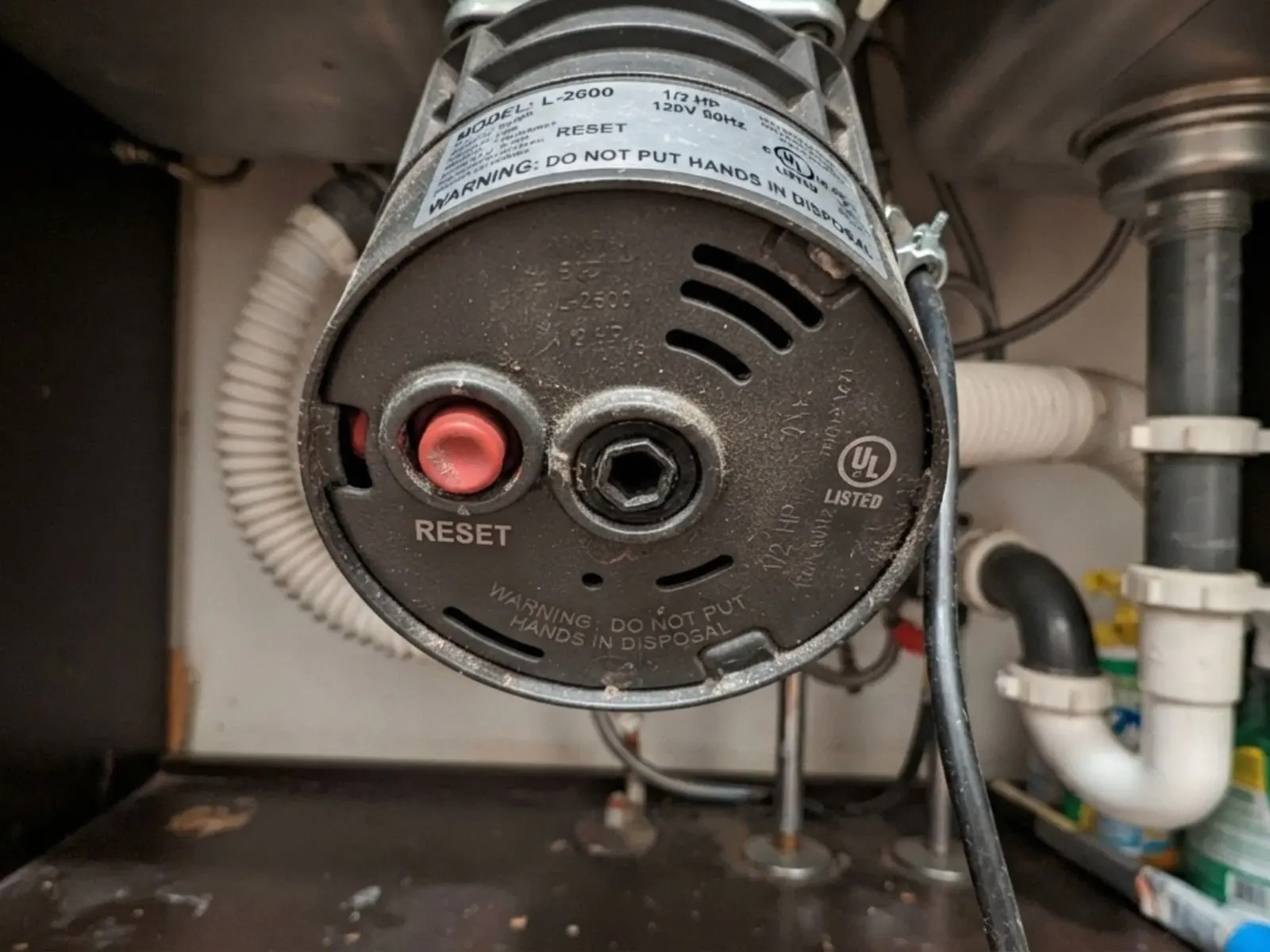
A leaking garbage disposal usually drips from the top flange, the dishwasher hose connection, the drain pipe or the unit body. The first three are repairable with a wrench and new gaskets. A leak from the body or a seam means the housing has failed, and the unit needs to be replaced.
Before you touch anything, turn off the power to the disposal at the switch and the breaker. Never put your hand inside the grinding chamber. Dry the cabinet floor, then run water and trace the drip with a dry paper towel.
The table below sorts the leak by where the water shows up. After that comes a section on repair or replace, a note on local permit rules and a short list of what to do while you wait for help.
Find the leak before you fix it
Wipe every surface dry, then run water into the sink for a minute and follow the drip upward.
| Where water appears | Likely cause | Can you fix it? |
|---|---|---|
| Around the top of the unit under the sink flange | Failed mounting gasket or loose mounting ring | Often yes, with a new gasket and an hour |
| From the side where the dishwasher hose attaches | Loose hose clamp or cracked inlet nipple | Usually yes, tighten or replace the clamp |
| From the discharge pipe at the side | Loose bolts or a worn gasket on the outlet flange | Usually yes |
| From the bottom or the body seam | Cracked housing or failed internal seal | No, the unit needs replacement |
| From the reset button | Water has reached the motor housing | No, replace the unit |
A leak that only appears while the dishwasher runs points to the hose or the nipple. A leak that appears every time water runs in the sink points to the flange or the drain.
Fixing the common leaks
With the power off and the cabinet cleared, these are the usual repairs.
Tighten the clamp and the bolts
Use a screwdriver on the dishwasher hose clamp and a wrench or screwdriver on the discharge flange bolts. Snug them evenly and do not overtighten the plastic.
Replace the discharge gasket
If the gasket is flattened or cracked, a new one costs little. Match it to the discharge flange on your unit.
Reseal the sink flange
Remove the mounting ring, clean the old plumber's putty off the sink and the flange, press a fresh rope of putty under the flange and reassemble.
Replace a cracked dishwasher nipple
The small inlet nipple can crack if the hose was forced on. Replace the nipple if you see a hairline crack.
Run water for several minutes after the repair and check every joint with a dry paper towel. A repair that holds in the first minute but drips later usually means a second leak was hidden behind the first one.
Repair or replace: the decision
A body leak is the end of the line
A disposal that leaks from its body has a cracked housing or a failed internal seal, and there is no good repair for it. The same is true of a disposal that is also jamming, humming or tripping its breaker, because those are signs of a motor or bearing failure.
If the unit is old and a gasket repair would take an hour on a unit that is already failing, replacement is usually the better choice. Our garbage disposal repair and installation crews can do either, and we explain which one makes sense before we start.
What the leak can damage if you wait
A slow disposal leak is not a flood, but it is a steady source of moisture under the sink. Particleboard cabinet floors swell and crumble, and the dampness invites mold on the back of the cabinet. Water that reaches the shutoff valves can cause them to corrode and stick.
If you see swelling, a musty smell or a soft spot in the cabinet floor, the leak has been going on for a while and the damage may extend into the wall or floor. A leak that traveled along a pipe is covered in our leak detection work, which finds the source without opening more of the wall than needed.
Maryland Heights local note: no permit for a like-for-like swap
The City of Maryland Heights includes replacing a garbage disposal or a dishwasher, with no relocation, on its list of ordinary repairs that do not need a plumbing permit. Stopping leaks and clearing stoppages are on the same list.
That means you can repair or replace a leaking disposal without a permit visit, as long as the unit stays where it is. If a new disposal means moving the drain or changing the sink layout, call the Community Development Building Division at (314) 291-6550 first.
Source: City of Maryland Heights, residential plumbing permits page (city government, Community Development Building Division).
While you wait for a plumber
Limit the damage tonight
- Turn off the disposal switch and the breaker.
- Close the shutoff valves under the sink if the leak is at the faucet or the supply lines.
- Put a bucket or a shallow pan under the leak and empty it often.
- Pull out stored items and dry the cabinet floor.
- Run the dishwasher only after the leak is fixed if the leak is at the hose connection.
We work in homes across Maryland Heights, Creve Coeur and Chesterfield, and the dispatcher can tell you whether we can come today.
Safety standards for disposals
Waste disposers are covered by the UL 430 standard, and the manufacturer's guidelines say to disconnect power before any repair. Unplug the unit or switch off its breaker before you reach near the flange, since a disposal can start if the wall switch is bumped.
Leaking garbage disposal questions
It is better not to. A leak can reach the motor, and a disposal that is wet inside can short out or trip the breaker. Turn it off until the leak is fixed.
No. A leak from the body or the bottom of the unit means the housing or an internal seal has failed, and the unit needs to be replaced.
The dishwasher drain hose connects to a nipple on the disposal. A loose clamp, a cracked nipple or a blocked disposal can push water out at that point.
It depends on use and the water. Units that jam, hum or leak from the body are near the end of their life, and a plumber can tell you if repair makes sense.
The city lists replacing a disposal with no relocation as ordinary repair that needs no permit. If the sink or drain moves, ask the building division at (314) 291-6550.