
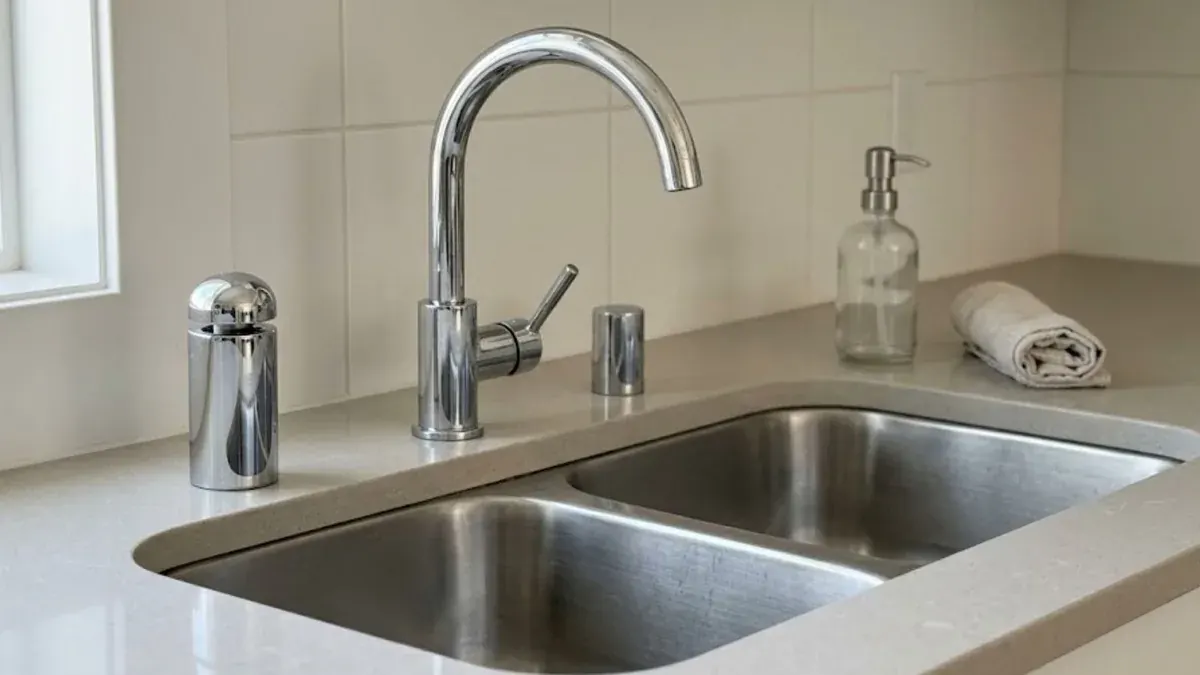
The standard way to plumb a double sink is to run both basin drains into a continuous waste tee, send that tee down to a single P-trap, and run the trap arm into the wall where it meets a vent. Two basins do not need two traps. One trap serves both sides, and it only works if the tee, the trap and the vent are all in the right order.
A disposal on one side and a dishwasher on the other add two more connections, and those are where most kitchens go wrong. The disposal outlet must feed the trap, and the dishwasher drain hose must loop up under the counter before it joins the disposal or the tee.
This guide walks through the parts, the hookups and the mistakes that cause slow drains and leaks. It is written for homeowners who want to understand the job or check a contractor's work, not as a replacement for a licensed plumber on a new or relocated sink.
The four parts that make a double sink drain
Start at the basins and work toward the wall. Each part has one job.
Basin strainers and tailpieces
Each basin has a strainer body and a straight tailpiece, usually 1-1/2 inch pipe, that drops below the sink. A disposal replaces the strainer on its side.
Continuous waste tee
A horizontal pipe with a center outlet joins the two tailpieces. The two basins empty into it, and the center outlet carries water down toward the trap.
P-trap
The U-shaped bend holds a small plug of water that blocks sewer gas. It sits below the tee and must be able to slip apart for cleaning.
Trap arm and vent
The trap arm runs into the wall at a gentle downward slope and meets a vent that lets air in behind the water. Without the vent, the trap can be siphoned dry or the drain will gurgle.
When all four parts are in place, both basins empty at the same speed and the trap stays full. If one side is slower than the other, the slope or a partial clog in the tee is the usual cause.
Where the disposal and dishwasher connect
If the left basin has a garbage disposal, its outlet is a short side pipe that connects to the trap or to the tee. The right basin then runs straight into the tee through its own tailpiece. This is why a double sink with a disposal often has an offset trap that looks different from the textbook drawing.
The dishwasher drain hose attaches to a small inlet nipple on the side of the disposal. That nipple is sealed with a plastic knockout plug at the factory, and the plug must be punched out before the hose is connected. A hose attached to a plugged nipple is one of the most common reasons a new dishwasher leaves a puddle of dirty water in the bottom of the tub.
Under the counter the hose should rise in a high loop, fastened near the top of the cabinet, before it drops to the disposal. That loop keeps sink water from flowing back into the dishwasher. If your kitchen has no disposal, the hose connects to a tailpiece branch or an air gap instead.
One trap or two: a quick comparison
Some older kitchens have a separate trap under each basin. Both layouts can work, but they behave differently over time.
| Layout | Works well when | Watch out for |
|---|---|---|
| One shared trap with a continuous waste tee | Both basins sit at the same height and the trap arm has a steady downward slope | A disposal on one side can force an offset that needs careful slope |
| Two separate traps joined at a wall tee | The old cabinet layout leaves no room for a tee between the basins | Twice as many joints and traps to clean, and more places to leak |
| Disposal plus tee on a shared trap | The disposal outlet is level with the tee and the trap sits low enough | A disposal outlet that sits too low can leave a standing pool of water in the trap arm |
If you are replacing a sink in an old kitchen with two traps, a plumber can usually combine them into a single shared trap. That change is a good time to look at the plumbing installation work needed for the rest of the cabinet, including the shutoff valves and supply lines.
Venting: why a double sink gurgles
Every trap needs air behind it. When water rushes down the drain it pushes air ahead of it and pulls a vacuum behind it, and the vent supplies the air that keeps the vacuum from emptying the trap. If the vent is missing, undersized or blocked, the sink will make a gurgling sound and may drain in short bursts.
Island sinks are the classic problem. With no wall behind the sink, the vent has to loop up under the counter and back down, and that loop must be built to code. If an island sink drains slowly even after the trap is cleaned, ask a plumber to check the vent before you replace anything.
A mechanical air admittance valve can serve as a vent in some kitchens, and many building departments allow them where a conventional vent is hard to reach. Rules differ by jurisdiction, so check with your local building division before you buy one.
Common double sink mistakes and what they cause
Check these before you blame the clog
- Trap arm sloped upward toward the wall. Water pools in the arm and grease builds up there.
- Trap installed backward or too deep. A trap below the wall opening can hold standing waste water.
- Dishwasher knockout plug not removed. The dishwasher drains slowly or not at all.
- Missing high loop on the dishwasher hose. Dirty water can flow back into the dishwasher.
- Plastic slip nuts overtightened or missing their washers. The joint drips slowly onto the cabinet floor.
- Mixed pipe sizes. A 1-1/4 inch tailpiece feeding a 1-1/2 inch tee catches debris at the step.
Most of these can be found with a flashlight and ten minutes under the sink. If you find one, fix it before running a cable or chemical cleaner, because the clog may be a symptom of the layout and not the cause.
Maryland Heights local note: permits for sink work
The City of Maryland Heights lists the replacement of a sink or faucet with no relocation as ordinary repair work that does not need a plumbing permit. The same list covers replacing a toilet, a disposal or a dishwasher. If your project moves the sink, adds a second sink or changes the drain or vent, the work is no longer a like-for-like swap.
The practical takeaway is simple. For a straight replacement, you can plan the job without a permit visit. For a relocation or a new island sink, call the Community Development Building Division at (314) 291-6550 and ask what applies before you open the wall.
Source: City of Maryland Heights, residential plumbing permits page (city government, Community Development Building Division).
When to call a plumber
Call a plumber if the sink is moving, if you need a new vent line, if the drain connects to cast iron that is rusted through or if a leak has soaked the cabinet floor. These jobs involve the wall, the vent and sometimes the floor, and a mistake can cause sewer gas or a hidden leak.
If the sink simply will not drain, the cause is often a clog in the trap or the branch line and not the layout. Our drain cleaning crews can clear it and check the trap, and we work in homes in Creve Coeur and Bridgeton as well as Maryland Heights.
Double sink plumbing questions
No. Two basins can share a single trap through a continuous waste tee, and that is the standard layout. Some older kitchens have two traps, but a plumber can combine them.
Yes. Without a disposal, the dishwasher drain hose connects to a branch tailpiece on the sink drain or to an air gap. The hose should still loop high under the counter.
The slower side usually has a partial clog in its tailpiece or a flatter run into the tee. A trap cleaning and a check of the slope will usually find the cause.
Occasional gurgling points to a venting problem or a partial clog beyond the trap. If it happens every time, have a plumber check the vent.
The City of Maryland Heights treats a replacement with no relocation as ordinary repair, but a relocation is different. Ask the building division at (314) 291-6550 before the work starts.