
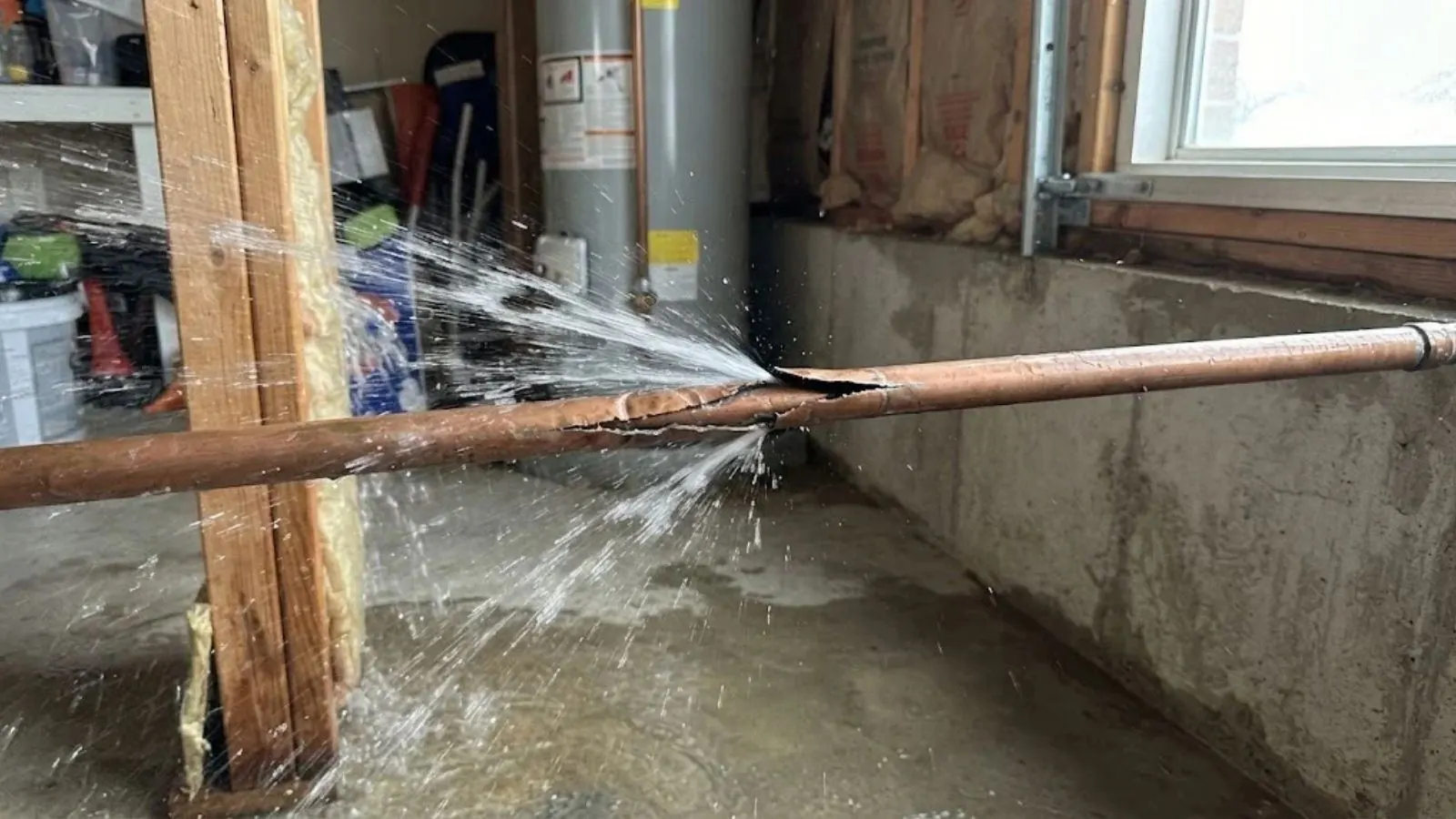
When a pipe bursts, do three things in order. Shut off the water at the main valve, switch off power to any wet room from the breaker panel, and open a faucet at the lowest level to drain the lines. Then call a plumber, because the pipe cannot be repaired until the water is off and the line is drained.
Once the water stops, the job becomes a repair and a cleanup. This guide covers the first hour, drying out, what to photograph for your insurer, how plumbers choose between a patch and a section replacement and where permits fit in.
If you need a crew right now, our burst pipe repair page has the emergency details and the 24/7 line.
The first hour, step by step
Shut off the main water valve
It is usually where the water line enters the house, often in a basement, utility room or crawlspace. Turn it clockwise until it stops.
Cut power to wet areas
Switch off the breakers for any room with standing water or wet outlets. Do not walk through water near electrical equipment.
Drain the lines
Open the lowest faucet and one upstairs faucet so the pipes empty and the leak slows.
Move belongings and start containing water
Lift furniture off wet floors, use towels and a wet vac and set out buckets under drips.
Photograph before you clean up
Take wide and close photos of the burst pipe, the wet areas and damaged items for your insurer.
Drying out without cutting corners
Water that stays in drywall, insulation and carpet padding for a day or two gives mold a place to start. Run fans and a dehumidifier, open cabinet doors under affected sinks and pull up wet padding quickly.
Porous materials soaked by a burst supply line are often removed rather than saved, so ask your restoration contractor or insurer what to keep. Keep what you throw out in photos until the claim is settled.
What to photograph and write down for your insurer
A simple claim checklist
- The burst section of pipe, before and after it is cut out.
- Every wet wall, ceiling and floor, with a ruler or coin for scale.
- Damaged belongings and their approximate age.
- The date, time and what you did to stop the water.
- The plumber's written description of the cause and the repair.
Sudden bursts are often treated differently from slow leaks, and policies vary a lot. Call your insurer before you sign off on repairs, and ask what they need to see.
Repair choices after a burst
The right repair depends on how much of the pipe is damaged and what the pipe is made of.
| Damage | Typical repair | What to know |
|---|---|---|
| One split in copper or PEX | Cut out the damaged section and splice in new pipe with fittings | Fast, and the rest of the line is tested |
| Several splits or pinholes | Replace a longer run or the whole branch | Repeated failures suggest the pipe is wearing out |
| Burst inside a wall | Open a small access, repair, then patch the wall | Locate the leak first to keep the opening small |
| Old galvanized pipe that keeps failing | Plan a repipe | See whole house repiping for how that is done |
Ask the plumber to pressure test the repaired line before the wall is closed. A test takes a few minutes and catches a bad fitting while it is still easy to reach.
Turning the water back on safely
Open the main valve slowly and listen for hissing. Check the repair, the water heater connections and any fixtures that were open while the lines were drained. Run each tap for a minute to clear air and sediment.
Watch the area for the next day or two. A small drip at a new fitting is easier to fix early than after a stain spreads.
Why the pipe burst in the first place
Freezing is the cause people expect, but it is not the only one. Water expands about nine percent as it turns to ice, and that pressure splits copper along its length or pops a fitting off its seat. Corrosion, a failed joint and sudden pressure spikes from a stuck valve can do the same thing in mild weather.
Look at where the split is. A long lengthwise crack in an exterior wall or crawlspace line points to freezing, while a pinhole or a green crust around a fitting points to age. A plumber who sees the pipe can tell you which, and the answer decides whether you repair one spot or the whole run.
If the damaged line runs from the meter into the house, a water line repair may be the better description of the job. Crews also work this kind of call in Hazelwood and Creve Coeur, so the same advice applies if you are just across the town line.
Questions to ask before you approve the repair
Ask the plumber
- Is this a single failure or a sign the whole line is worn?
- Will you pressure test the line before the wall is closed?
- What will you do about the water heater connections after the water was shut off?
- Will you give me a written description of the cause for my insurer?
Maryland Heights local note: permits and who to call
The City of Maryland Heights lists stopping leaks as ordinary repair that does not need a permit. For larger work, it says a permit can be pulled without plans for repairing or replacing interior or exterior water lines. Before a long section is replaced, ask the Building Division at (314) 291-6550 what applies, since the answer depends on the scope.
If the burst is on the utility's side of the meter rather than in your house, Missouri American Water can be reached at 1-866-430-0820. Knowing which side of the meter failed saves a wasted call.
Sources: City of Maryland Heights residential plumbing permits page and city utilities contact page (primary, municipal).
Pipe standards behind the repair
Copper tube is made to ASTM B88 and PEX tubing to ASTM F876, and the repair fitting has to be rated for the pipe that broke. Ask the plumber to name both before cutting, because a mismatched fitting is a common reason a repair fails later.
After a burst pipe
Shut off the water and call a plumber first, because stopping the damage matters most. Call your insurer the same day and document everything.
A single accessible split is often repaired in one visit. Pipes inside walls or several failures take longer because of access and testing.
Push-fit couplings can stop a small split temporarily, but a lasting repair needs correct fittings and a pressure test. A plumber can do that in one visit.
A single frozen-pipe split usually will not. Several failures in an older line mean the pipe is wearing out, and a repipe is worth discussing.
Stopping a leak is ordinary repair under the city's list, while repairing or replacing interior or exterior water lines can be permitted without plans. Call the Building Division at (314) 291-6550 to confirm your case.