
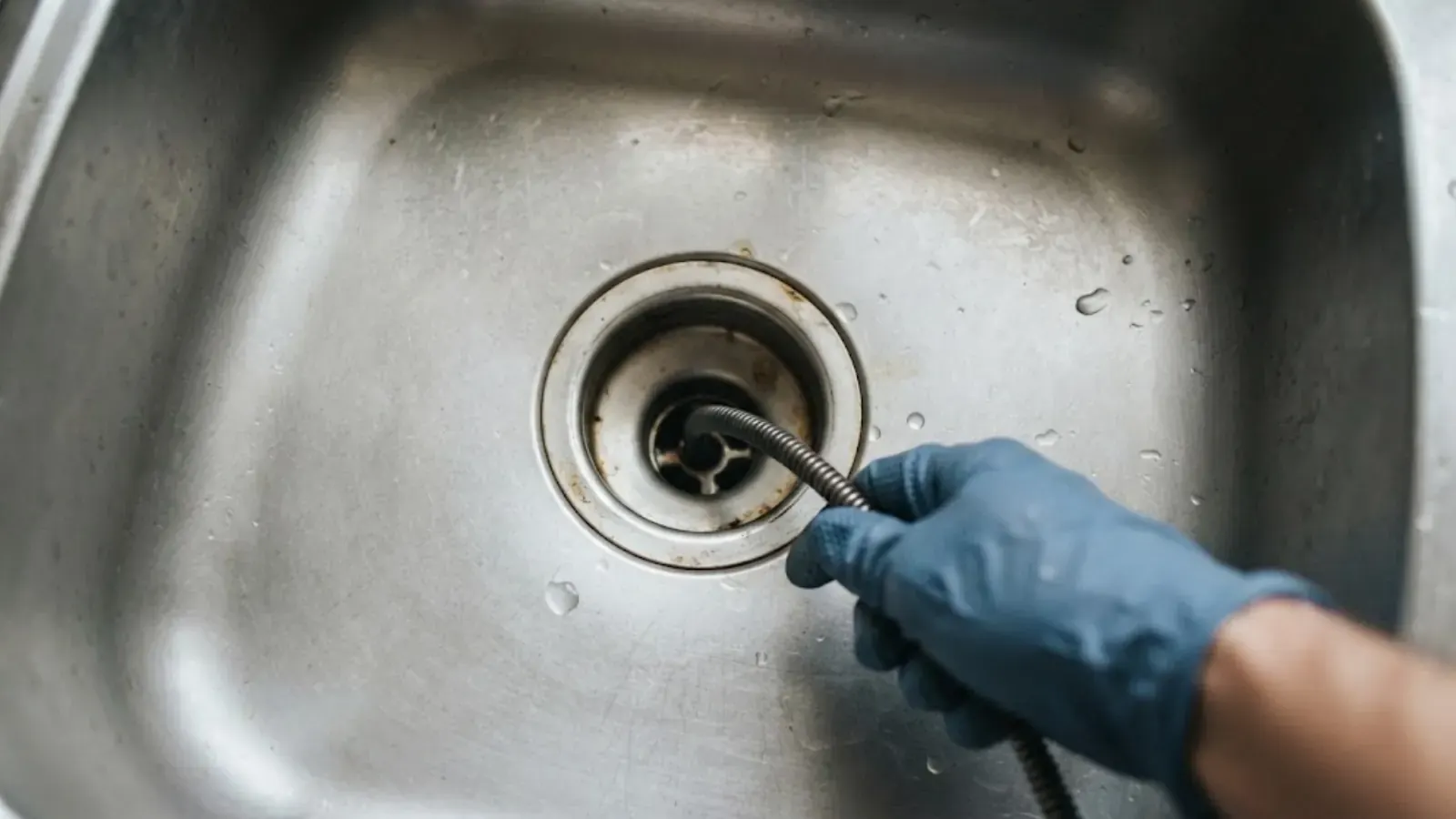
Water that sinks slowly but does drain is the early stage of a clog. Hair, soap scum, toothpaste and grease coat the inside of the trap and the pipe behind it, narrowing the path a little at a time. The sink never blocks completely, so people live with it for months.
Start at the stopper and the trap, because those two parts cause most slow bathroom and kitchen drains. If the sink still crawls after you clean them, look at whether other fixtures are slow too, since that points at the main line.
This guide covers the bathroom and kitchen versions separately, then shows how to tell a vent problem from a blockage.
Five reasons a sink drains slowly with nothing stuck
A coating inside the trap
Soap, toothpaste and hair form a sticky lining. The opening shrinks until water barely passes.
A pop-up stopper holding hair
The stopper rod and its pivot collect a mat of hair just below the drain opening.
Grease film in a kitchen line
Warm grease cools and hardens inside the pipe, leaving a rough wall that catches food.
A partly blocked vent
Plumbing vents let air in behind the water. If the vent is blocked, the drain slows and gurgles.
A restriction in the shared branch or main
When several fixtures run slow, the shared pipe downstream is narrowed or sagging.
Bathroom sink: the stopper and the first six inches
In a bathroom sink, the problem is usually within an arm's reach of the drain. Lift out the stopper, wipe off the hair and slime, and clean the pivot rod behind the tailpiece. A small plastic drain tool or a pair of needle-nose pliers pulls out the mat that a cable would only push deeper.
If the stopper is clean and the sink is still slow, place a bucket under the trap, unscrew the slip nuts and rinse the trap into the bucket. Reassemble with the washers seated, and run water while you watch for drips at both nuts.
Avoid pouring chemical cleaner into a slow sink. It sits on top of a partial clog and can splash back or soften the trap's plastic, and it does not cut through hair at all.
Kitchen sink: grease film and the disposal side
Kitchen lines carry grease that bathrooms never see. Even with hot water and soap, fat cools two or three feet down the pipe and builds a thin wall of wax, which food scraps then catch on.
If you have a double sink, test each basin. When only the disposal side is slow, the problem often sits at the disposal outlet or the dishwasher connection, which a garbage disposal repair visit can check. When both basins are slow, the trap arm or the wall branch is narrowed.
A good habit is to run hot water for a minute after the disposal and wipe greasy pans before washing them. It will not clear an old film, but it slows a new one.
How a vent problem sounds and feels
Plumbing vents are easy to forget until they fail. A blocked vent changes how the drain behaves in ways a plain clog does not.
| What you notice | Plain partial clog | Vent problem |
|---|---|---|
| Gurgling after the water leaves | Rare | Common |
| Slow drain only when other fixtures run | Sometimes | Common |
| Water level drops in a smooth, slow slide | Yes | Often jerky, with air bubbles |
| Sewer odor in the bathroom | Rare | More likely |
| Cleaning the trap helps | Yes | Only briefly |
Vents exit through the roof, so a plumber should check them with a camera or a smoke test rather than you climbing up. If the symptoms match the right column, book drain cleaning with a vent check.
When the slowness is really the main line
Signs the problem is bigger than one sink
- A shower or tub drains slowly at the same time as the sink.
- The toilet gurgles when you run the sink or washing machine.
- A floor drain or the lowest fixture in the house bubbles or shows water.
- The slowness returns within days of clearing a trap.
Those signs point to a shared pipe or the sewer lateral. At that stage a sewer camera inspection shows what is narrowing the line, and it is cheaper to find out early than after a backup.
Maryland Heights local note: who handles what
The City of Maryland Heights lists clearing stoppages, replacing a sink or faucet with no relocation and stopping leaks as ordinary repair that does not need a permit. That means a trap cleanout or a faucet swap on a slow sink is something you or a plumber can do without paperwork.
The sewer lateral that serves your house is owned by the homeowner according to the city. If the slow drain turns out to be a root-filled or collapsed lateral, the repair is yours, and the city's lateral repair program can help with approved repairs. Public Works at (314) 291-6550 can explain how to apply.
Our crews take the same slow-drain calls in Bridgeton and Creve Coeur. If your house sits just across the line from Maryland Heights, call and give the cross streets before you decide whether to pull the trap yourself.
Sources: City of Maryland Heights residential plumbing permits page and Sewer Lateral Program page (primary, municipal).
Slow drain questions
A partial blockage in the trap or at the stopper is the most common reason. Hair and soap scum narrow the opening, and the sink drains but slowly.
It can loosen light film in a trap but will not remove hair or grease. If the drain is still slow after one try, clean the trap by hand.
Yes. A blocked vent lets air in poorly, so water leaves with gurgling and a slow slide. A plumber can check the vent with a camera.
Usually not, but it is a warning. If several fixtures are slow or a floor drain is bubbling, treat it as a main line problem and call soon.
No. The city lists clearing stoppages as ordinary repair that does not need a permit, while relocating fixtures or repairing a lateral is different. Ask the Building Division at (314) 291-6550 if you are unsure.