
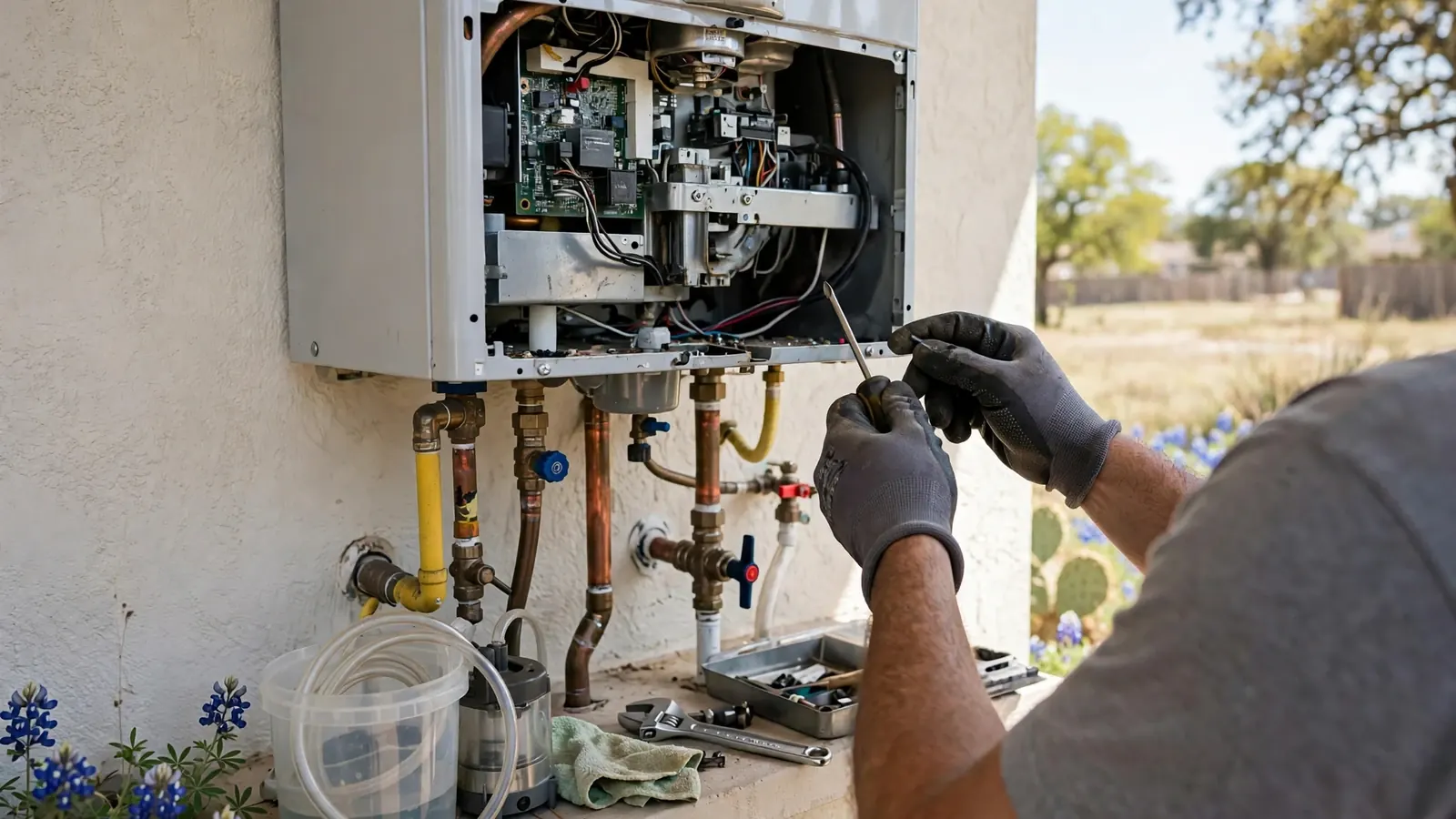
A like-for-like tankless swap on a home that already has the right gas line, vent and drain is the simple end of the range. The price climbs when the new unit needs a bigger gas supply, a different vent material, a condensate drain or a new electrical outlet. Those four items explain most of the gap between two quotes for the same model.
Before you pay for a replacement, find out whether the old unit is actually finished. Many tankless heaters that throw an error code or run lukewarm only need a flush, and that is a much smaller job than a new heater.
The sections below walk through what moves the price, what to ask for in writing and when a tank unit is the smarter buy for a Maryland Heights home.
What sets the price of a tankless replacement
Plumbers price tankless jobs from the same short list of factors. Ask which of these apply to your house.
Gas line capacity
Tankless units burn gas at a much higher rate than a tank for a short burst. If the existing gas line is sized for a tank, the run may need to be upsized.
Venting type
Some models need stainless steel vent pipe and others use PVC. Changing the vent route through a wall or roof adds labor.
Condensate drain
High-efficiency condensing units produce acidic water that must drain to a floor drain or a neutralizer, so the install needs a drain nearby.
Electrical and water fittings
Gas units still need a nearby outlet. Isolation valves for flushing and a pressure relief connection are worth adding while the pipes are open.
The unit and its size
Flow rate and temperature rise decide the model. A house with three bathrooms needs a larger unit than a one-bath condo.
Timing matters too. A planned replacement on a weekday costs less in labor than a failure at night, which is why a unit that is acting up is better replaced on your schedule. Our tankless water heater service page covers repair, flushing and installation in one place.
Like-for-like swap or a new setup?
The same unit can be a short visit or a multi-day project depending on what the walls already hold.
| Your situation | What changes on the job | Effect on the price |
|---|---|---|
| Same model or close match, vent and gas intact | Disconnect, swap, reconnect, test | Lowest end of the range |
| New model with a different vent size | New vent pipe and wall or roof penetration | Moderate increase |
| Moving from a tank to tankless | Gas upsizing, vent, drain, wall mounting, removal of the tank | Highest end of the range |
| Electric tankless replacing gas | Large electrical circuit and panel capacity | Depends on the panel |
If you are moving from a tank, the job looks more like a fresh water heater installation than a swap, and the quote should be itemized that way.
Gas line and venting: the upgrades that surprise people
A tank heater trickles gas into a burner all day. A tankless unit fires hard the moment you open a tap, so the gas meter, regulator and pipe all have to deliver more at once. A plumber measures the length of the run and the fittings before promising that the old line will work.
Venting is the second surprise. Condensing units run cooler exhaust that must slope back toward the unit and drain, while non-condensing units exhaust hotter and need a different pipe. Mixing the wrong material with the wrong unit is a safety problem, so the manufacturer's vent chart settles the question.
If you ever smell gas near a heater, leave the building and call Spire at (314) 621-6960 or 911 before you call a plumber.
Flush and descale before you replace anything
Scale on the heat exchanger causes many of the complaints that sound like a dead heater. Work through this sequence before you buy a new one.
Read the error code
The code on the display usually names the problem, such as ignition, flow or exhaust. Write it down for the plumber.
Check the basics
Confirm the gas valve is open, the inlet screen is clear and a fixture is not mixing hot and cold inside the wall.
Flush the heat exchanger
With isolation valves, a pump circulates a descaling solution through the unit. If your unit has no isolation valves, they can be added.
Retest and decide
If the code clears and the water runs hot, you saved a replacement. If scale has already damaged the exchanger, replacement is the honest answer.
Hard water is why this matters here. Missouri American Water's 2021 report for its St. Louis County system lists measurable hardness, so a unit that is never flushed collects scale faster than owners expect. A hard-water check is a good question to raise with a Chesterfield or Maryland Heights plumber before you size a unit.
When a tankless unit is not worth it
A tank unit may fit better if
- Your gas line or vent would need major rebuilding and the savings will not cover that work.
- The house has a single bathroom and low hot water demand, so a tank rarely runs short.
- You will not flush the unit on a schedule, because scale shortens the life of the heat exchanger.
- The home may be sold soon, and the buyer will care more about a working heater than the type.
- Hot water demand is heavy at one time, such as two showers and a dishwasher, and the unit is not sized for it.
For a household in Creve Coeur or Maryland Heights with several bathrooms, tankless often wins. A smaller home may do just as well with a tank, and a plumber should tell you which.
Maryland Heights local note: permits and water
The City of Maryland Heights says a permit can be pulled without plans for replacing water heaters up to 120 gallons, and it lists the Building Division at (314) 291-6550. The page does not mention tankless units specifically, so ask the division whether your gas or electric tankless swap needs a permit before work starts.
Water in the city comes from Missouri American Water. The utility's 2021 water quality report for its St. Louis County system describes lime-softened surface water and lists total hardness at its Missouri River plants from 76 to 170 ppm as calcium carbonate, which is about 4.4 to 9.9 grains per gallon. That means scale on a heat exchanger is a real possibility, so plan a flush schedule and test your tap.
Sources: City of Maryland Heights residential plumbing permits page (primary, municipal) and Missouri American Water's 2021 water quality report for its St. Louis County system (primary, utility).
Standards that affect a tankless swap
Gas tankless units are built to ANSI Z21.10.3 and electric ones to UL 174, and the manufacturer's installation standard sets the venting and gas line size. A like-for-like swap is the cheapest case, because the vent and gas line are already sized.
Tankless replacement questions
Often yes. Error codes, clogged inlet screens and scale on the heat exchanger are common and fixable. A plumber should read the code and flush the unit before recommending a replacement.
Gas line upgrades, vent changes, condensate drains and electrical work vary from house to house. Ask each plumber to list those items so you compare the same scope.
It depends on your water. Hard water builds scale faster, so a plumber can set a schedule after testing your tap, and isolation valves make each flush quick.
It can be, since it only heats water on demand. The payoff shrinks in a one-bath home with low use, and the upgrade costs may outweigh the savings.
The city's permit page names water heaters up to 120 gallons and does not address tankless units on their own. Call the Building Division at (314) 291-6550 with your model and fuel type to confirm.