
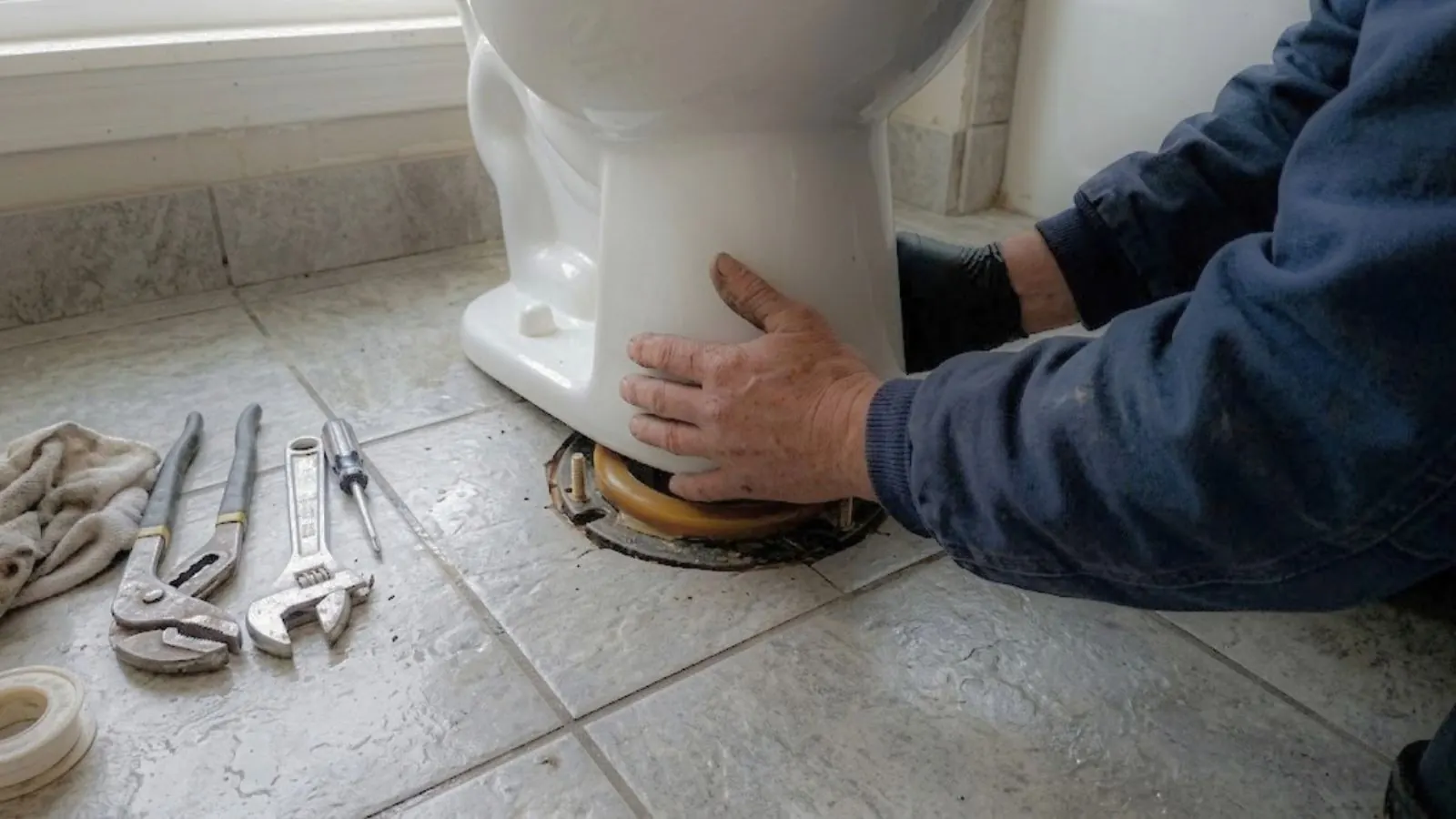
To install a wax ring, shut off the water, drain the toilet and lift it off the closet bolts. Scrape the old wax from the flange and check that the flange is solid and level with the floor. Press a new ring onto the horn of the bowl or onto the flange, set the toilet straight down and tighten the nuts evenly. Then flush and check for leaks.
The hardest part is not the ring. It is the flange. A cracked, rusted or sunken flange will let even a new ring leak, and a flange that sits below the floor surface leaves a gap that wax cannot fill.
Below are the tools, the steps and the flange checks, followed by the signs that mean it is time to call a plumber and a note on local permits.
Signs the wax ring has failed
A failed seal shows up in a few ways
- Water on the floor around the base, especially after flushing.
- A toilet that rocks even slightly when you sit on it.
- A sewer smell near the toilet that does not go away after cleaning.
- A stain or soft spot in the floor around the base, or a ceiling stain below the bathroom.
Do not confuse a base leak with condensation or a leaking supply line. Dry the base, wrap a few sheets of toilet paper around the bottom and flush. If the paper is wet, the seal is the problem.
Tools and parts to have ready
Wax ring or wax-free seal
A standard ring fits most flanges. A thicker ring or a ring with a plastic horn helps if the flange sits slightly low.
New closet bolts
Reuse only if they are in good shape. New brass bolts and nuts are cheap and stop the toilet from shifting.
Putty knife and rags
To scrape the old wax from the flange and the base of the bowl.
Adjustable wrench and a sponge
To shut off the supply line, remove the nuts and sponge out the last water from the bowl.
Flange repair ring or extender
Only needed if the flange is cracked or low. Have one on hand before you lift the toilet.
Helper or a dolly
A toilet can weigh more than 70 pounds, and a second person keeps you from dropping it.
Replacing the ring: the steps
Take your time with the setting. The bowl goes down once and it should not be rocked back and forth.
Shut off and drain
Close the supply valve, flush and hold the handle, then sponge the last water out of the bowl and tank. Disconnect the supply line.
Remove the toilet
Take the caps and nuts off the closet bolts, rock the toilet gently to break the seal and lift it straight up. Set it on towels, not on its side.
Clean the flange
Scrape every trace of old wax off the flange and the bowl outlet. Stuff a rag in the drain opening to block sewer gas while you work.
Check the flange
It should be solid, round, level and at or slightly above the finished floor. Replace or repair it if it is cracked, rusted or loose.
Set the new ring
Press the ring onto the bowl outlet or the flange, install the closet bolts, then lower the toilet straight down with the bolts through the holes.
Tighten evenly
Add washers and nuts and tighten a little on each side, alternating. Stop when the toilet is firm. Overtightening cracks porcelain.
Reconnect and test
Reconnect the supply line, open the valve, let the tank fill and flush several times. Check around the base and the supply line for drips.
The flange: the part that decides whether it holds
When the toilet is off, look at the flange before you place the ring.
| Flange condition | What it means | Fix |
|---|---|---|
| Solid, level, at floor height | The ring can seal normally | Install a standard ring |
| Sits below the floor surface | A gap that a standard ring cannot fill | Use a thicker ring or add a flange extender |
| Cracked or rusted | The bolts cannot hold the toilet steady | Fit a repair ring or replace the flange |
| Loose or spinning on the subfloor | The subfloor may be soft or damaged | Call a plumber and check the floor |
A subfloor that is soft or stained dark around the flange means the leak has been going on for some time. In that case the repair is bigger than a ring, and our toilet repair and installation crews can assess the flange and floor together.
Maryland Heights local note: toilet swaps and permits
The City of Maryland Heights lists replacing a toilet with no relocation as ordinary repair that does not need a plumbing permit. Resetting a toilet on a new wax ring falls in the same category, since the fixture stays where it is.
If your project moves the toilet, replaces the flange and part of the drain below the floor or adds a new bathroom, the work goes beyond a like-for-like swap. Ask the Community Development Building Division at (314) 291-6550 which rules apply before you open the floor.
Source: City of Maryland Heights, residential plumbing permits page (city government, Community Development Building Division).
When to call a plumber
Call a plumber if the flange is broken, if the floor is soft, if the toilet sits over a concrete slab with a damaged drain or if the toilet still leaks after a new ring. These problems often involve the pipe below the floor, and that is beyond a quick DIY.
If the toilet keeps clogging along with the leak, the problem may be farther down the line. Our plumbing installation crews can reset a toilet with new parts, and homeowners in Bridgeton and Hazelwood can call the same dispatch line as Maryland Heights residents.
Toilet wax ring questions
No. Once a wax ring has been compressed, it will not reseal reliably. Always use a new ring when you lift the toilet.
Both can work. A wax ring is inexpensive and common. A wax-free seal is reusable and forgiving of a slightly low flange. Match the choice to your flange height.
Snug and even on both sides. The toilet should not rock, but overtightening can crack the porcelain.
A cracked flange, a flange below the floor surface or a toilet that was rocked while setting are the usual causes. A plumber can check the flange.
The city lists replacing a toilet with no relocation as ordinary repair. For a relocation or flange and drain work, call the building division at (314) 291-6550.