
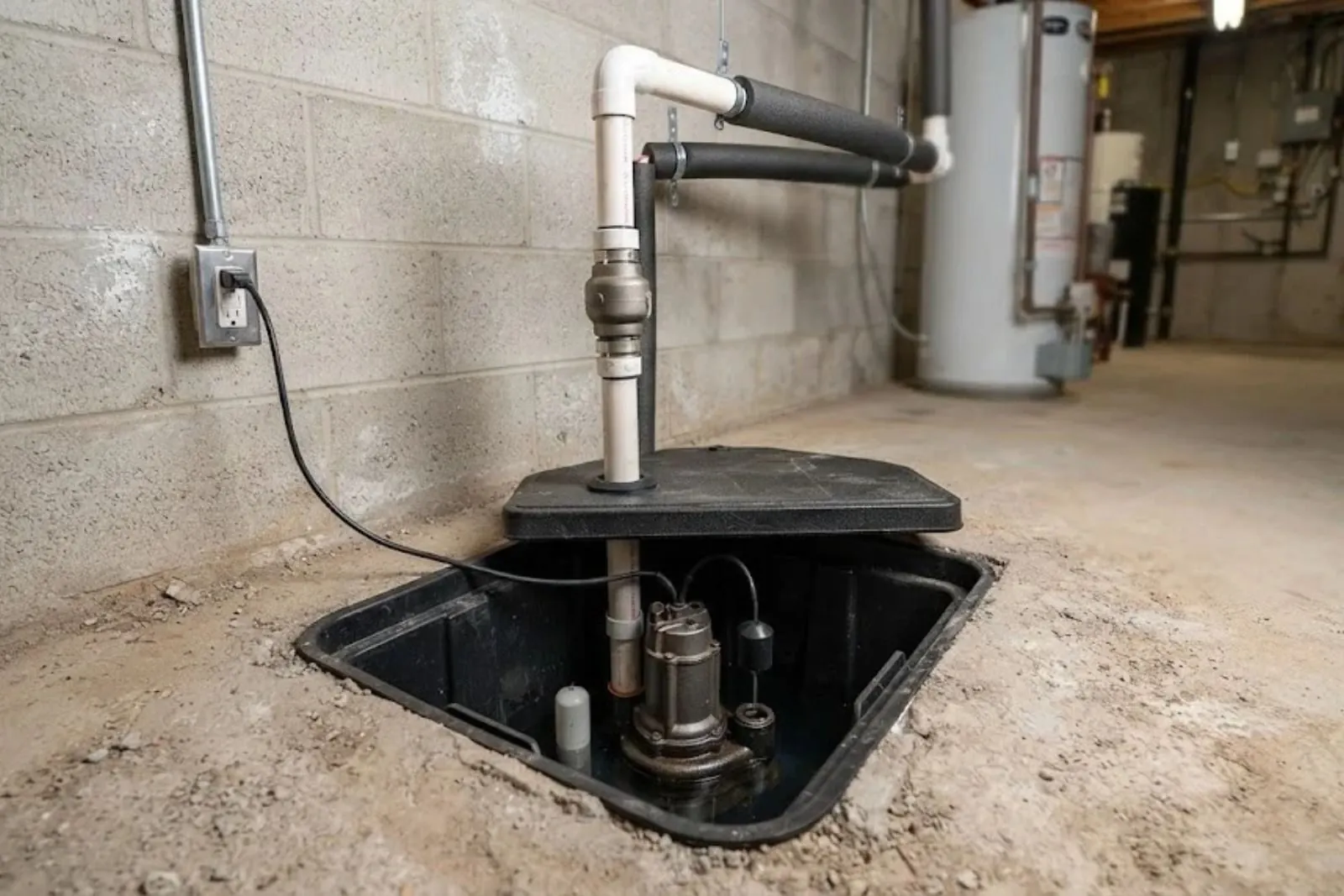
A water-powered backup mounts above or beside your main sump pump and connects to a cold-water line. When the main pump fails or the power goes out, a float lifts and opens a valve. Supply water rushes through a venturi, which pulls sump water along with it and sends both out the discharge line.
Because it needs no electricity, it keeps running through a long outage. The trade-off is that it uses supply water while it works and depends on the water pressure being there when you need it.
This guide explains how it works, how it compares with a battery backup and what to check before you install one in Maryland Heights.
How a water-powered backup actually works
The float rises
Water in the sump pit rises past the point where the main pump should have cut in. The backup float lifts and opens a valve.
Supply water flows through a venturi
Pressurized water from the house line passes through a narrow nozzle and creates suction.
Sump water is pulled out
The suction draws pit water into the stream and carries it up the discharge pipe.
The float drops and it shuts off
When the pit level falls, the valve closes and the supply water stops.
Most units are a backup only. A working primary pump, set properly, should do the real work, and a failed primary is a reason to call for sump pump repair.
Water powered or battery backup: the honest comparison
| Feature | Water powered | Battery backup |
|---|---|---|
| Needs household power | No | Only to charge the battery |
| Run time in a long outage | As long as water pressure holds | Limited by battery capacity |
| Uses household water | Yes, while it runs | No |
| Needs water pressure | Yes, and fails if the supply is cut | No |
| Routine upkeep | Test the float and valve | Replace the battery on a schedule |
| Moves a lot of water fast | Moderate, depends on pressure | Depends on the pump size |
Neither type replaces a healthy primary pump. Many homes pair a battery unit with their main pump, and a water-powered backup suits homes where outages are long and the water supply is reliable.
When a water-powered backup makes sense
It is a good fit when a basement floods during storms that also take out power for hours. It also suits homeowners who do not want to replace a battery every few years.
It is a poor fit if the house has weak water pressure, if the water supply may be shut off during repairs or if the discharge line is long and poorly sloped. In those homes a battery or generator-powered pump may be better.
What installation involves
Parts and connections
- A tee on a cold-water line, with a shutoff valve so the backup can be isolated.
- A check valve so sump water cannot flow back into the supply line.
- A discharge connection that ties into the existing sump discharge or runs out separately.
- A float that is set above the main pump's float so the backup only starts when the primary fails.
- A test routine, because a backup that is never tested may not work when you need it.
A plumber also checks that supply water and sump water cannot mix, and asks the building division which rules apply. That is the main reason to have a licensed plumber set it up rather than treat it as a do-it-yourself project. Our basement waterproofing page covers the wider picture of keeping a basement dry.
Testing and upkeep through the year
A backup that never runs is a backup nobody has tested. Pour a few buckets of water into the pit until the primary float rises, then lift the backup float by hand and listen for the hiss of water through the venturi. The pit level should drop within a minute or two.
Check the supply shutoff valve and the check valve each spring. Look for mineral crust at the nozzle, because scale narrows the opening and weakens the suction. A yearly look is cheap protection.
Homes in Bridgeton and Hazelwood sit near the same river bottomland, so the same test routine applies there. A plumbing installation visit is the right time to add a shutoff and test port if your setup lacks them.
Maryland Heights local note: utility and rules
Water in Maryland Heights comes from Missouri American Water, which can be reached at 1-866-430-0820. Because a water-powered backup depends on supply pressure, ask the utility about planned main work on your street. A 2021 project on McKelvey Road replaced aging pipe and the utility warned of temporary outages and low pressure, which would also reduce a water-powered backup's strength.
The City of Maryland Heights lists a permit as possible without plans for interior water lines, so ask the Building Division at (314) 291-6550 whether tying a backup into your supply line needs one. The city's page does not mention backup pumps directly, so confirm before work starts.
Sources: City of Maryland Heights residential plumbing permits page and Missouri American Water 2021 McKelvey Road project notice (primary, municipal and utility).
What the standards and the utility say
Pumps that move water out of a pit are covered by UL 778, and water powered units also depend on the utility's rules about backflow into the supply. Ask Missouri American Water at 1-866-430-0820 and the building division at (314) 291-6550 whether a water powered unit is allowed on your service.
Backup sump pump questions
Yes. It runs on the pressure of your home's water supply, so a power outage does not stop it as long as the supply holds.
It consumes supply water while it runs, so use depends on how long the backup is active. That is the main running cost compared with a battery unit.
No. It is designed as a backup that starts when the primary pump fails. Keep the primary pump in good order.
Neither wins in every home. Water powered suits long outages with reliable water pressure, while battery units suit homes that cannot rely on supply pressure.
Missouri American Water supplies the water and the city's Building Division covers permits. Call the Building Division at (314) 291-6550 before installation to confirm what applies to your home.